Showing posts with label Jesus. Show all posts
Showing posts with label Jesus. Show all posts
Saturday, August 06, 2011
Transfiguration
This sermon is posted here. It was written for the "Sermons That Work" series and also delivered in a modified form to St. John's in Silsbee.
Sunday, December 26, 2010
Being vs. Becoming
What's the difference in being and becoming? For instance, what's the difference in being an electrician and becoming an electrician? With 'being,' you're already there; you already are. With 'becoming,' you're headed that way, and when you get there, you will be something new.
Being is static, unchanging; becoming is moving toward something.
Jesus was God, and he became a person.
We are people, and Jesus has given us the ability to become children of God.
Jesus moved toward us and reached us; once he got here, he began helping us move toward God.
Popeye
Let's consider Popeye for a minute. You know, Popeye the Sailorman... What is his philosophy of existence?
I yam what I yam
I AM WHO I AM.
Verbs in Hebrew are different than in English. In English, we're very concerned with when something happened (past, present, future); Hebrew is more interested in whether the action is finished or not. So "I am who I am" could be translated "I will be who I will be" or some other combination of tenses that imply continuing action. God's name may also mean "I am who I have been" "I am who I will be" "I will be who I have been" "I will be who I am"In the Middle Ages, philosophers and theologians got very interested in the idea of perfection and whether God changes. For the most part, they decided that, if God is perfect, God can't change. So, they figured that God always has been who God always will be. You can't improve on perfection.
But we're not God, although it's unclear whether we know that, from the way people talk about themselves. "It's hard to improve on perfection" – I've seen that on T-shirts and truck windows. Actually, such a statement is ridiculous. Really? You're just like God? For us to wave off a call to change, for us to say 'Hey, I am what I am' is not even close to a valid comparison.
We can change; we need to change.
Instead of "I am what I am," it's much more appropriate for us to say
"I'm not who I wanna be and
I'm not who I'm gonna be,
but, thank God, I'm not who I was."
Hamlet
Let's change characters. When you hear 'Hamlet' what's the first thing you think of? Give me a line.
To be or not to be: that is the question...
This is another angle from which to consider being.Hamlet is definitely emo; but he's the star of a tragedy, so... And this is his darkly-shining moment – wrestling internally to figure his way forward in an exquisite, impossible situation. He only sees two options – to be or not to be. Both bad choices – to continue as he is and suffer or to end his life, not knowing what waits on the other side of death.
But just because he only sees two options doesn't mean there only ARE two options. His problem is a lack of imagination. He can imagine only being like he is (which doesn't take any imagination at all, since he is like he is) or not being. And actually, he can't imagine not being, which scares him, so he decides to stick being as he is, even though he doesn't like it.
One of the many angles he doesn't consider is whether he or his situation, or anyone else in it, might change.
God is in the business of transformation. You are what you are, but this doesn't have to determine who you become. You have already changed in countless ways to become someone neither you nor anyone else could imagine when you first began to be.
Human 'Beans'
When your parents discovered they were going to have a baby, you were probably about the size of a bean.
Who were you then?
Who have you become?
Who did he become?
Remember the difference in being and becoming?
'Being,' you are. 'Becoming,' you're getting there, and when you get there, you will be something new. Because of Jesus, who we are doesn't have to determine who we become. With his help, we can become something new.
Amen.
Sunday, August 29, 2010
Homework...
Gospel Reading: Luke 14:1,7-14
Not for a place of honor did your Son come among us, O god of the lowly, but to invite to the wedding feast the poor, the crippled, the blind and the lame. Let such humility grace our table and lead us to renounce the quest for power and privilege. … Amen.
It seems there is a common theme lately in sermons to this community. A lot of them seem to be focusing on breaking attachments to money and power and other things that serve as pseudo-security in place of God.
Here is the same topic again today – in Jeremiah, the prophet talks about the people forgetting and turning their back on all God did for them, his continual provision and faithfulness: rescuing them from Egypt, leading them through the wilderness – through a land no one survives in – and bringing them into a land where there is plenty. Instead of remembering that they owe all their current prosperity to God, they start attributing it to themselves and to other gods. Through Jeremiah, God laments, “My people have changed their glory for something that does not profit… they have forsaken me, the fountain of living water, and dug out cisterns for themselves, cracked cisterns that can hold no water.”
In the Psalm, we hear again God’s promise to take care of his people’s needs, as he has continually done in the past, and his wish that they would accept what he wants to give them.
I’m not sure why this keeps being the theme of sermons here. Maybe it’s something this community particularly needs to hear – or maybe it’s just a topic everybody needs to have reiterated. Probably both. Are you aware if it’s sinking in for you?
Money is not security; God is security.
Money is not ultimately of any value; God is of ultimate value.
Money may or may not even get you daily bread; God provides for your every need.
Money is only useful if you can trade it for what you need or want, but if what you need isn’t available, money won’t get it for you, and if the person who has what you need doesn’t want money for it, there again, money is not use. We’ve seen also that money can very easily and very quickly lose value and even become completely worthless. And it’s of no use at all in obtaining things of really great value.
“Will you be my friend? I’ll give you a hundred dollars…”
“Will you drop the charges against me? I’ll give you a hundred dollars…”
“Will you marry me? I’ll give you a hundred dollars…”
“I want to be a senator. I’ll give you a hundred dollars…”
“Can I have an indulgence to erase my sins? I’ll give you a hundred dollars…”
When people try to trade money for these things, it becomes a scandal – money, in these situations, actually reduces the value of what it’s traded for. Inappropriate use of money in these areas fosters disillusionment: with the political system, with the church, with relationships… it cheapens them, it makes them seem untrustworthy. Why? Because these things are based on a higher value than money.
For some things that have really ultimate value, money is not even a scandal, it’s just a joke.
“God, will you let me in? I’ll give you a hundred dollars…”
What does God have to do with money? Does God buy things? He owns the cattle on a thousand hills – he doesn’t need anything from us. It’s the other way around, he gives us everything. What do we have that we have not been given?
But still, it’s habit to hang onto our things, our abilities, our relationships, even our lives, as though they are ours and not God’s. And we try to get more by taking from each other. An outward representation of that is what Jesus saw at a party: people schmoosing and trying to network and make connections to power and wealth to get up the ladder, trying to sit closest to the host of the party, to be seen as more important. Parties are often still like this – you’ve got some folks trying to sit with or talk to certain other folks – the kids who are more popular, the bosses who are more powerful, the stars who are bigger celebrities. At the same time, people are trying to avoid and get away from those they feel are lower than themselves or might somehow pull them down.
But Jesus says we’re not to be like that – from either side. Neither the brown-nosers nor the snobs.
As one commentator, David Lose, noted, Jesus is not just being Miss Manners when he talks to people about how to act at parties – and who to invite. This business about who sits closest to the host is about pecking order, but Jesus says forget the pecking order – it’s the other way around. Don’t try to sit in the highest seat; sit in the lowest. Don’t try to be the king; be everyone’s servant.
And if you’re the one who’s throwing the party, don’t invite people you want to impress, people you think can help you advance your career, your station in life. You scratch their back and they’ll scratch yours. No, don’t do that – that doesn’t earn you any favor with God, because there’s nothing hospitable or generous about it; it’s a calculated investment, but whatever you get back is all the benefit there is to that kind of transaction. It doesn’t win you any points in heaven.
No, if you want to invest in something truly valuable, try to do something to win God’s favor – as Jesus advises. Do something good for someone who can’t do anything for you. Invite people to your party who can’t even bring the bean dip.
Since this money and economy and giving topic seems to keep coming up, possibly it’s something we need to learn better. In school, when a concept is difficult to grasp with just a lecture, the teacher gives you some homework to practice…
I think that’s a good idea to implement in church. Lots of times, people just come to church and listen to the lecture, and I don’t know how much application of the learning takes place afterwards. I guess that’s fine if you’re just auditing, but really, why even audit a course unless you actually want to learn the material?
So, I’m giving a homework assignment. Now, I’m not the teacher; you won’t turn it in to me. Jesus is the teacher; I’m just subbing today. But this is some of the material he left for us to work on.
Not for a place of honor did your Son come among us, O god of the lowly, but to invite to the wedding feast the poor, the crippled, the blind and the lame. Let such humility grace our table and lead us to renounce the quest for power and privilege. … Amen.
(From Prayers for Sunday and Seasons, Year C, Peter J. Scagnelli, LTP, 1992.)
It seems there is a common theme lately in sermons to this community. A lot of them seem to be focusing on breaking attachments to money and power and other things that serve as pseudo-security in place of God.
Here is the same topic again today – in Jeremiah, the prophet talks about the people forgetting and turning their back on all God did for them, his continual provision and faithfulness: rescuing them from Egypt, leading them through the wilderness – through a land no one survives in – and bringing them into a land where there is plenty. Instead of remembering that they owe all their current prosperity to God, they start attributing it to themselves and to other gods. Through Jeremiah, God laments, “My people have changed their glory for something that does not profit… they have forsaken me, the fountain of living water, and dug out cisterns for themselves, cracked cisterns that can hold no water.”
In the Psalm, we hear again God’s promise to take care of his people’s needs, as he has continually done in the past, and his wish that they would accept what he wants to give them.
I am the LORD your God, who brought you out of the land of Egypt and said,Hebrews is very straightforward in its advice.
"Open your mouth wide, and I will fill it." … O that my people would listen to me.
Keep your lives free from the love of money and be content with what you have. Do not neglect to do good and to share what you have.
I’m not sure why this keeps being the theme of sermons here. Maybe it’s something this community particularly needs to hear – or maybe it’s just a topic everybody needs to have reiterated. Probably both. Are you aware if it’s sinking in for you?
Money is not security; God is security.
Money is not ultimately of any value; God is of ultimate value.
Money may or may not even get you daily bread; God provides for your every need.
Money is only useful if you can trade it for what you need or want, but if what you need isn’t available, money won’t get it for you, and if the person who has what you need doesn’t want money for it, there again, money is not use. We’ve seen also that money can very easily and very quickly lose value and even become completely worthless. And it’s of no use at all in obtaining things of really great value.
“Will you be my friend? I’ll give you a hundred dollars…”
“Will you drop the charges against me? I’ll give you a hundred dollars…”
“Will you marry me? I’ll give you a hundred dollars…”
“I want to be a senator. I’ll give you a hundred dollars…”
“Can I have an indulgence to erase my sins? I’ll give you a hundred dollars…”
When people try to trade money for these things, it becomes a scandal – money, in these situations, actually reduces the value of what it’s traded for. Inappropriate use of money in these areas fosters disillusionment: with the political system, with the church, with relationships… it cheapens them, it makes them seem untrustworthy. Why? Because these things are based on a higher value than money.
For some things that have really ultimate value, money is not even a scandal, it’s just a joke.
“God, will you let me in? I’ll give you a hundred dollars…”
What does God have to do with money? Does God buy things? He owns the cattle on a thousand hills – he doesn’t need anything from us. It’s the other way around, he gives us everything. What do we have that we have not been given?
But still, it’s habit to hang onto our things, our abilities, our relationships, even our lives, as though they are ours and not God’s. And we try to get more by taking from each other. An outward representation of that is what Jesus saw at a party: people schmoosing and trying to network and make connections to power and wealth to get up the ladder, trying to sit closest to the host of the party, to be seen as more important. Parties are often still like this – you’ve got some folks trying to sit with or talk to certain other folks – the kids who are more popular, the bosses who are more powerful, the stars who are bigger celebrities. At the same time, people are trying to avoid and get away from those they feel are lower than themselves or might somehow pull them down.
But Jesus says we’re not to be like that – from either side. Neither the brown-nosers nor the snobs.
As one commentator, David Lose, noted, Jesus is not just being Miss Manners when he talks to people about how to act at parties – and who to invite. This business about who sits closest to the host is about pecking order, but Jesus says forget the pecking order – it’s the other way around. Don’t try to sit in the highest seat; sit in the lowest. Don’t try to be the king; be everyone’s servant.
And if you’re the one who’s throwing the party, don’t invite people you want to impress, people you think can help you advance your career, your station in life. You scratch their back and they’ll scratch yours. No, don’t do that – that doesn’t earn you any favor with God, because there’s nothing hospitable or generous about it; it’s a calculated investment, but whatever you get back is all the benefit there is to that kind of transaction. It doesn’t win you any points in heaven.
No, if you want to invest in something truly valuable, try to do something to win God’s favor – as Jesus advises. Do something good for someone who can’t do anything for you. Invite people to your party who can’t even bring the bean dip.
Since this money and economy and giving topic seems to keep coming up, possibly it’s something we need to learn better. In school, when a concept is difficult to grasp with just a lecture, the teacher gives you some homework to practice…
I think that’s a good idea to implement in church. Lots of times, people just come to church and listen to the lecture, and I don’t know how much application of the learning takes place afterwards. I guess that’s fine if you’re just auditing, but really, why even audit a course unless you actually want to learn the material?
So, I’m giving a homework assignment. Now, I’m not the teacher; you won’t turn it in to me. Jesus is the teacher; I’m just subbing today. But this is some of the material he left for us to work on.
Monday, May 31, 2010
Trinity
Readings for Trinity Sunday, Year C Illustrated bulletin insert
God, you yourself are a community: Father, Son and Holy Spirit; help us to model our life together after your love in the Trinity.
Today is Trinity Sunday – and tomorrow is Memorial Day.
Do you remember what we’re remembering on Memorial Day? Got an email this week from several people with a cartoon by Joe Heller showing a guy in a baseball hat, sunglasses and an apron leaning over his barbecue grill - “Hotdogs, Hamburgers, Bratwurst… Is there anything I forgot?” while in the smoke above the grill, you can see the faces of soldiers who sacrificed their lives, part of a bigger picture that’s obscured when we forget our history.
When we don’t understand or remember the bigger story and what others have given for our sake, we may treat what we’ve received lightly or even throw it away. When we don’t realize our part in the bigger story, the only story that matters is our own, and by itself, it’s very small.
As part of St. John’s, we are part of the Episcopal Church, and the Anglican Communion, and the Church universal from the past and into the future. It’s important to remember the bigger story we’re part of.
For Christians, every Sunday is a Memorial Day – “we remember his death; we proclaim his resurrection…” Everything we do in a Sunday service - every part of the liturgy, every action, every word, every piece of art on the walls, every sound, every taste - is designed to help us remember, to ingrain the story of who we are and who God is into the fabric of our being. Our language resonates with the different tones of Father, Son and Holy Spirit and our understanding of those relationships.
What is the Trinity? There are many doctrinal formulations and descriptions, many symbols and analogies to try and help people remember this central understanding of our faith in God. Take a look at the insert in your bulletin. The historical documents of our church say that the Trinity is “one God: Father, Son and Holy Spirit” (BCP - Catechism, p. 852)“Three Persons, of one substance…” (Articles of Religion, Article I, BCP p. 867)
If you take a look sometime at the Athanasian creed, it gets very involved.
But words don’t really capture the relationship of the members of the Trinity. People have tried with images also. The inside of your insert explains some of this visual symbolic vocabulary.
St. Patrick’s famous shamrock,
the Celtic triquetra knot,
various combinations of circles and triangles, conveying that the Trinity has both “one-ness” and “three-ness.”
You can also combine symbols of the Father, the Son and the Spirit with these to show distinctions among the members.
 More complex designs combine words and images show that while the three Persons of the Trinity are all God, they have distinct identities; they are not the same as each other. The Shield of the Trinity is based on the Athanasian Creed - The Trinity window in Trinity Episcopal Church in Galveston is a circular version of the shield diagram.
But symbols can’t capture the identities of the members of the Trinity either. As Sandra Schneiders, a Roman Catholic nun, observed, “God is more than two men and a bird.” The Trinity is more than words or symbols can convey, but symbols can help us focus on important aspects of God’s character. These interlocking circles here on the front of the pulpit, for instance, show that the members of the Trinity are equal, each whole, and each inextricably joined to the others. How could it inform our life together if we understood and lived the truth that we are all equal, whole and inextricably joined to each other and to God?
On the back of your insert is a much more complex and nuanced representation of the Trinity – Rublev’s icon. Here, three people are presented, not just shapes or symbols or words, and we can read from their expressions and gestures something about their relationships.

One thing to notice is all the faces are the same, because all are God. As Jesus said to Philip in last week's Gospel when Philip asked to see the Father… “Have I been with you all this time, Philip, and you still do not know me? Whoever has seen me has seen the Father.” (Jn 14:8-9)
The angels are all looking at each other, and their wings overlap each other, showing their close relationship, and their attentiveness to each other. To be in relationship, then, means not only that our lives intersect and overlap at points, but we need to consciously pay attention to each other, to see and hear one another.
The three are seated around a table, with food; their relationship isn’t only talk, but includes hospitality and enjoyment. And there are four sides to the table but only three guests; the open seat is closest to us, and we are invited to join in. So while we love each other and consciously work to sustain our relationships, we should also always look to welcome new members into our community through hospitality.
Bishop Ian Douglas of Connecticut said,
Even when you’re paying attention and trying to move together, it can be tricky; imagine if you were to try dancing without paying attention to who you’re dancing with, or even ignoring them… You’re going to step on each other and trip or go opposite ways and maybe yank each other over – any of which will look very un-graceful.
Sometimes, the church is very ungraceful in the way it dances together. But God is not.
The Rev. Joyce and I were talking about the Trinity at Starbucks Thursday night, and afterwards she sent me an email – she had been thinking more about this metaphor of the dance, and she sent me something she read from the Rev. Charles Hoffacker:
There are different kinds of fear that keep us away from things. One is fear of actual danger. Fr. John talked last week about Pentecost, and how the Holy Spirit is like wind and fire – dangerous and unpredictable. So it’s reasonable to be afraid of allowing the Spirit free reign in your life. It could be dangerous. But then again, there’s courage, and courage is a response to fear when you’re trusting something more certain – and it’s more certain that God loves us. Not that it’s a guarantee nothing scary will happen. It might - God might dip you nearly to the floor – or swing you up over his head – in fact, we ought probably to expect something like that, because he’s kind of crazy sometimes. But the thing is, he won’t drop you.
If the dance metaphor doesn’t work for you, you might also think of this life with the Trinity as cultivating a garden, like in The Shack, where the Holy Spirit is planting and pruning and moving things around in your life. The next 24 weeks, in the long, green growing season after Pentecost, something ought to start sprouting and producing some fruit in you. Don’t be surprised. The Church does its best to make sure the Word gets planted every week (and every day, too).
Then, sometimes when people or events in your life poke holes in your heart, God takes that opportunity to push the seeds further down – and often some manure gets thrown in, too. Take heart...
This is a prime growing environment!
So actually, if something doesn’t grow in you these next few months, that should be the more surprising and concerning thing – and maybe you will want to think about how to rehabilitate your soil...
During this long, green growing season, tend your garden and see what God’s been planting as it starts to come up and bloom.
Amen.
God, you yourself are a community: Father, Son and Holy Spirit; help us to model our life together after your love in the Trinity.
Today is Trinity Sunday – and tomorrow is Memorial Day.
Do you remember what we’re remembering on Memorial Day? Got an email this week from several people with a cartoon by Joe Heller showing a guy in a baseball hat, sunglasses and an apron leaning over his barbecue grill - “Hotdogs, Hamburgers, Bratwurst… Is there anything I forgot?” while in the smoke above the grill, you can see the faces of soldiers who sacrificed their lives, part of a bigger picture that’s obscured when we forget our history.

When we don’t understand or remember the bigger story and what others have given for our sake, we may treat what we’ve received lightly or even throw it away. When we don’t realize our part in the bigger story, the only story that matters is our own, and by itself, it’s very small.
As part of St. John’s, we are part of the Episcopal Church, and the Anglican Communion, and the Church universal from the past and into the future. It’s important to remember the bigger story we’re part of.
For Christians, every Sunday is a Memorial Day – “we remember his death; we proclaim his resurrection…” Everything we do in a Sunday service - every part of the liturgy, every action, every word, every piece of art on the walls, every sound, every taste - is designed to help us remember, to ingrain the story of who we are and who God is into the fabric of our being. Our language resonates with the different tones of Father, Son and Holy Spirit and our understanding of those relationships.
Glory to you, Lord Christ...The Trinity forms the basis and model for the community of the Church and for every relationship we participate in: family, church, school, work, city, nation… We learn best from the Trinity how to be part of a community, part of God’s bigger picture.
Our Father, who art in heaven…thy kingdom come...Cleanse the thoughts of our hearts by the inspiration of your Holy Spirit…We believe in one God…
What is the Trinity? There are many doctrinal formulations and descriptions, many symbols and analogies to try and help people remember this central understanding of our faith in God. Take a look at the insert in your bulletin. The historical documents of our church say that the Trinity is “one God: Father, Son and Holy Spirit” (BCP - Catechism, p. 852)“Three Persons, of one substance…” (Articles of Religion, Article I, BCP p. 867)
If you take a look sometime at the Athanasian creed, it gets very involved.
But words don’t really capture the relationship of the members of the Trinity. People have tried with images also. The inside of your insert explains some of this visual symbolic vocabulary.
St. Patrick’s famous shamrock,
the Celtic triquetra knot,
various combinations of circles and triangles, conveying that the Trinity has both “one-ness” and “three-ness.”
You can also combine symbols of the Father, the Son and the Spirit with these to show distinctions among the members.
 More complex designs combine words and images show that while the three Persons of the Trinity are all God, they have distinct identities; they are not the same as each other. The Shield of the Trinity is based on the Athanasian Creed - The Trinity window in Trinity Episcopal Church in Galveston is a circular version of the shield diagram.
But symbols can’t capture the identities of the members of the Trinity either. As Sandra Schneiders, a Roman Catholic nun, observed, “God is more than two men and a bird.” The Trinity is more than words or symbols can convey, but symbols can help us focus on important aspects of God’s character. These interlocking circles here on the front of the pulpit, for instance, show that the members of the Trinity are equal, each whole, and each inextricably joined to the others. How could it inform our life together if we understood and lived the truth that we are all equal, whole and inextricably joined to each other and to God?
On the back of your insert is a much more complex and nuanced representation of the Trinity – Rublev’s icon. Here, three people are presented, not just shapes or symbols or words, and we can read from their expressions and gestures something about their relationships.
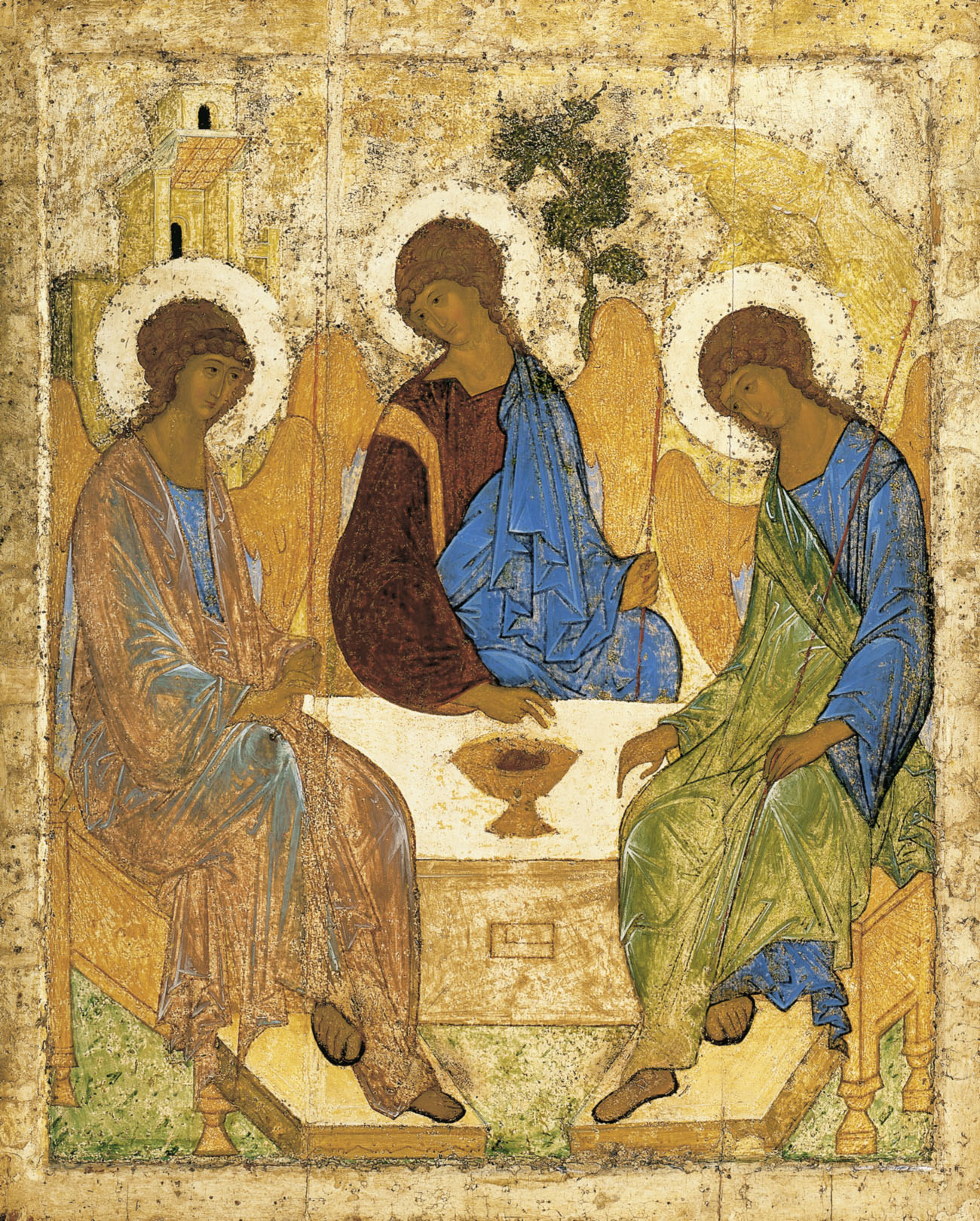
One thing to notice is all the faces are the same, because all are God. As Jesus said to Philip in last week's Gospel when Philip asked to see the Father… “Have I been with you all this time, Philip, and you still do not know me? Whoever has seen me has seen the Father.” (Jn 14:8-9)
The angels are all looking at each other, and their wings overlap each other, showing their close relationship, and their attentiveness to each other. To be in relationship, then, means not only that our lives intersect and overlap at points, but we need to consciously pay attention to each other, to see and hear one another.
The three are seated around a table, with food; their relationship isn’t only talk, but includes hospitality and enjoyment. And there are four sides to the table but only three guests; the open seat is closest to us, and we are invited to join in. So while we love each other and consciously work to sustain our relationships, we should also always look to welcome new members into our community through hospitality.
(Here is one in-depth analysis of the imagery, and here is a reflection on the icon, and another reflection)
Bishop Ian Douglas of Connecticut said,
The Trinitarian God is a God whose very nature is one of relationality, whose very essence is defined by relationship. Our Trinitarian God is thus a God of community, a divine community of love.The Rev. Joyce Wilkinson commented on this thought that
We can’t be a Christian alone; even our God is a community.In a different analogy, the relationship of the Trinity was described by St. John of Damascus in the 8th century as a three-person dance (his word was perichoresis), requiring each one to pay close attention to the others in order to move together gracefully. Let’s see them try that in Dancing with the Stars!
Even when you’re paying attention and trying to move together, it can be tricky; imagine if you were to try dancing without paying attention to who you’re dancing with, or even ignoring them… You’re going to step on each other and trip or go opposite ways and maybe yank each other over – any of which will look very un-graceful.
Sometimes, the church is very ungraceful in the way it dances together. But God is not.
The Rev. Joyce and I were talking about the Trinity at Starbucks Thursday night, and afterwards she sent me an email – she had been thinking more about this metaphor of the dance, and she sent me something she read from the Rev. Charles Hoffacker:
The Trinity is unending, joyous dance, yet the wonder is that the circle breaks open,… inviting us in…Amazingly, God wants us as dance partners, and he doesn’t seem to mind that we are ungraceful, because he loves us. I’m a terrible dancer, though ironically, I love the idea of dancing and would like to learn to do it well, but I always feel nervous about agreeing to dance with someone because I’m worried about being so bad at it and getting embarrassed. But if I trust the person, I can relax and try to follow them, and I end up enjoying the dance. I think it’s like that with God; once we start to trust him and pay attention to where he’s going and try to go with him, we begin to enjoy the dance and worry less whether every step is perfect.
There are different kinds of fear that keep us away from things. One is fear of actual danger. Fr. John talked last week about Pentecost, and how the Holy Spirit is like wind and fire – dangerous and unpredictable. So it’s reasonable to be afraid of allowing the Spirit free reign in your life. It could be dangerous. But then again, there’s courage, and courage is a response to fear when you’re trusting something more certain – and it’s more certain that God loves us. Not that it’s a guarantee nothing scary will happen. It might - God might dip you nearly to the floor – or swing you up over his head – in fact, we ought probably to expect something like that, because he’s kind of crazy sometimes. But the thing is, he won’t drop you.
If the dance metaphor doesn’t work for you, you might also think of this life with the Trinity as cultivating a garden, like in The Shack, where the Holy Spirit is planting and pruning and moving things around in your life. The next 24 weeks, in the long, green growing season after Pentecost, something ought to start sprouting and producing some fruit in you. Don’t be surprised. The Church does its best to make sure the Word gets planted every week (and every day, too).
Then, sometimes when people or events in your life poke holes in your heart, God takes that opportunity to push the seeds further down – and often some manure gets thrown in, too. Take heart...
This is a prime growing environment!
So actually, if something doesn’t grow in you these next few months, that should be the more surprising and concerning thing – and maybe you will want to think about how to rehabilitate your soil...
During this long, green growing season, tend your garden and see what God’s been planting as it starts to come up and bloom.
Amen.
Monday, April 05, 2010
First Word
When they came to the place called the Skull, there they crucified him, along with the criminals--one on his right, the other on his left. Jesus said, "Father, forgive them, for they do not know what they are doing." And they divided up his clothes by casting lots. (Lk 23:33-34)
Who have you crucified?
Nobody? Come on…
What’s the maddest you’ve ever been?
– so mad it scared you and you try to forget about it?
Who did you turn on?
What did you do to them?
Have you ever talked about it since?
Who has most deeply offended and disappointed you?A teacher? Public official? Sports figure? The president? A priest?
What did they do? Or at least… what was the accusation? (In public opinion court, it’s the same thing…) Did they molest a child, embezzle money, have an affair? … or in some other way not live up to expectations?
What was the response of the community? of the news?
And where were you in the mix? Did you shoot your arrows with the rest – or were you out front yelling ‘fire!’, doing “a dirty job that somebody’s gotta do.”
What about the time you were accused…
when they needed the blame to fit somebody, and you were called in to answer.
“So, who was responsible for this?”
Even if it wasn’t you, who did you throw under the bus?
If not any of these, there are always sins of omission...
failing to render aid…
Whose trouble have you so successfully looked past, ignored so that it’s just annoying background noise?
Not our finest hour – any of these.
And from up there, he has seen it all.
But we can join his gracious prayer: Father, forgive me… I didn't know what I was doing.
Who have you crucified?
Nobody? Come on…
What’s the maddest you’ve ever been?
– so mad it scared you and you try to forget about it?
Who did you turn on?
What did you do to them?
Have you ever talked about it since?
Who has most deeply offended and disappointed you?A teacher? Public official? Sports figure? The president? A priest?
What did they do? Or at least… what was the accusation? (In public opinion court, it’s the same thing…) Did they molest a child, embezzle money, have an affair? … or in some other way not live up to expectations?
What was the response of the community? of the news?
And where were you in the mix? Did you shoot your arrows with the rest – or were you out front yelling ‘fire!’, doing “a dirty job that somebody’s gotta do.”
What about the time you were accused…
when they needed the blame to fit somebody, and you were called in to answer.
“So, who was responsible for this?”
Even if it wasn’t you, who did you throw under the bus?
If not any of these, there are always sins of omission...
failing to render aid…
Whose trouble have you so successfully looked past, ignored so that it’s just annoying background noise?
Not our finest hour – any of these.
And from up there, he has seen it all.
But we can join his gracious prayer: Father, forgive me… I didn't know what I was doing.
Sunday, March 21, 2010
Bless the dying
5th Sunday in Lent, Year C - Readings
Mary anoints Jesus' feet with aromatic oil and wipes them with her hair; the house fills with the fragrance of the perfume. What is she doing? Jesus explains that she is anointing him for burial.

Not long before, Mary had rubbed the same kind of oil on her brother Lazarus's feet and helped wrap his body with spices in long strips of cloth before they buried him. Earlier, when Lazarus was sick, they had sent word to Jesus, but he hadn't come, and her brother died. She cried for days. Then finally Jesus came, and he raised her brother from the dead.
Before we go further, I want to clarify some mix-ups that you may have about Mary and about this situation.
You are not alone (but you are also not correct) if you think this is Mary Magdalene. You're also wrong if you assume she is or ever was a prostitute. But this is not completely your fault; it used to be an official interpretation, articulated by Pope Gregory in a sermon in 591. Now, however, people officially agree this interpretation was wrong, but it's hard to change a story people have become so committed to. ("Mary Magdalene: Saint or Sinner?")

There are a lot of Marys in the Bible: there's Mary, the mother of Jesus, Mary Magdalene, Mary the wife of Clopas, Mary the mother of Joses and Salome, and "the other Mary" as well as this Mary – Mary of Bethany. But you can't just amalgamate them.
Imagine if we decided: It's too confusing to have three Carols in our congregation. From now on, let's just say they are all the same Carol. Won't that make things clearer?
We also have several Johns: we even have several Father Johns in our history. Why not, for the sake of economy, just combine them all into one conglomerate priest we could name "Fr. John William Bedingfield Sonnen" – "Fr. John" for short. And if there are priests whose names we don't remember, they can also be included as part of "Fr. John."
This is basically what happened to Mary of Bethany. But she is her own person, and who she is and what she does in this story are important in the Gospel, which is also part of our story.
We are Christians; Jesus is the Christ, and Mary of Bethany is someone who acted toward Jesus in a way that was exactly appropriate. As Episcopalians, we also strive to act in ways that are exactly appropriate in each situation – so it would be good for us to pay attention to Mary of Bethany.
Who was Mary of Bethany, and what allows her to respond to Jesus in a way that is so fitting?
Mary of Bethany is that same Mary of Mary & Martha fame – she sat a Jesus' feet while her sister was busy in the kitchen, and when Martha complained to Jesus that he should make her help with the work, Jesus said, Leave her alone; she's doing the right thing.

In this story, Judas is complaining about his sister's behavior. She has basically just poured a year's salary down the drain as far as he's concerned, so he complains to Jesus about the waste. Like he'd said to Martha, Jesus tells Judas, Leave her alone - she's doing exactly the right thing.
A lot of commentaries make what I consider to be a patronizing and idiotic assumption that when Mary poured the perfumed oil on Jesus feet, she had really no understanding of what she was doing or why.
I think she knew what she was doing. There is a long tradition of people, particularly the prophets, acting out messages: Jeremiah wearing a yoke to illustrate Israel's enslavement, Hosea marrying a prostitute to show how God is faithful to his unfaithful people, Ezekiel making a tiny model of Jerusalem and besieging it, and on and on – and they all did these things intentionally, putting the meaning into words later.
In the same way, Jesus put into words the meaning of Mary's actions, to clarify what she was doing and why. Every week, we do something similar when we participate in the Eucharist to remember Jesus' sacrifice for us and the new life we have in his new life: "We remember his death. We proclaim his resurrection…" Actions help us remember, and the words explain the meaning.
When it comes to memory, the senses are the best triggers - and the most powerful is the sense of smell. Nothing can pull you so powerfully or so quickly back into a particular time or place as a familiar smell. In this story, it's clear that people remembered the smell of the perfume filling the hosue, because they specifically wrote that into the story. The smell was a powerful part of their memory of what happened there. What might it have triggered for them on that night?
If people at that time were familiar with preparing bodies for burial, those smells would already be associated for them pretty powerfully, but especially for that particular family. Remember, it was not long ago that Lazarus had been raised from the dead – but before that, he died and had to be anointed for burial.
+Lazarus-small.jpg)
Martha stands nearby, the smell taking her even a few days further back, to the day of her brother's death: no time to grieve, too much to do, but then working together with her sister to prepare his body for burial, closing his beautiful eyes and then finally binding his face in white linen cloth. When Lazarus came out of the tomb four days later, restored – it was like a dream. After Jesus brought her brother back, it seemed impossible to imagine that smell ever coming into their home again – but here it was, filling her with fresh grief, even though her brother was sitting at the table in front of her, alive. How is it possible to equate that smell with Jesus? How could it be possible that he would die?
This is a family very recently acquainted with death, so it may be that not everybody needed to have it explained. Except Judas – all he could smell was money. But possibly for the others, a much deeper realization was settling in. Just because Lazarus had been raised, that didn't mean death would never touch them again. It would – very soon.
Mary paid attention and knew Jesus well enough to realize that this man, whom they loved and who had done so much for them, was preparing to die. As impossible as that seemed to be to imagine or accept, she had already accepted it and she had made preparations. Now, though she didn't want it to be, the time was right, and the house began to fill with the fragrance as she poured out her offering of love and grief.
Some of the most beautiful and mysterious works we perform as a Church are our prayers and service for those who are dying. Many of you have experience of offering this kind of service to those you love.
Mary of Bethany blessed Jesus in this way. May we take her as a model for how to "bless the dying, soothe the suffering and pity the afflicted." (BCP p.134 from the service of Compline in the Daily Office)
Amen.
Given to St. John's, Silsbee on March 21, 2010
Sunday, February 14, 2010
Shine in our hearts

Readings
Let's reflect a bit today on theophany – that's a word for things like what we just read, Moses seeing God face to face and the disciples seeing Jesus transfigured into light and talking to Moses and Elijah, and God's voice coming out of a cloud.
Theophany is when God reveals himself in ways that we can't deny, when God shows up in ways that freak us out because they are so real, when something happens that moves us so deeply, we either say or do idiotic things trying to make some kind of response - or we don't' talk about it at all because we can't find any words that will work to really convey what happened.
You may not often talk about those experiences, or maybe you only tell one other person or a couple of people you really trust, but there is no way you can ever forget what you saw or what you heard or what you felt in that moment. And there's no way you can go back to how it was not knowing that things like that are real. Even though later, you may question whether you dreamed it or imagined it, deep down you know you didn't make it up.
And I think we hope that what we experience in moments like that is the true reality. We hope that what we see around us in mundane daily life is just a pale reflection of the way things really are, what life really is at the core. The difficulty in hope, though is it's a (seemingly) very fragile thing, and you hesitate to lay it out completely because you're not sure it could survive disappointment. Or maybe you know somehow deeply that if you completely hope for all you desire, there's no way you could stay in control – you'd be at the mercy of how God responds. And if you laid out your deepest hope to God, you couldn't stay aloof from him and safe from what you fear would happen if you found that God either doesn't want or isn't able to fulfill what you hope for – that your hope may in fact be foundationless. You think your hope is what keeps you alive, and you couldn't survive losing it.
So you hedge your prayers, you pray for what seems reasonable, for what God couldn't refuse; you pray in ways that give God an "out" in case he doesn't answer or doesn't want to or maybe isn't actually able to – because maybe he doesn't actually exist …
But why do you think we have hopes if there isn't actually a reality they're based on? Thomas Aquinas hashed this question out from both the theological and philosophical point of view, and he says we're right to hope - because God does exist and God is good – and he hasn't made a desire without its object. We have hope because there is such a thing as its fulfillment. Aquinas says that if we have a desire, not only does its object exist, but it's attainable and it's also good – in fact, it's intended. God isn't cruel – he hasn't made us so that we hope for things that don't exist or are bad for us or that he has no intention of giving us – so that we'll eternally be frustrated in our deepest desires.
No, God is good, and he's given us good desires, and he's also put in us a desire for himself as the greatest good, so when moments of theophany happen, we are getting a glimpse, a taste of what is most deeply true about God's relationship to us and his love for us.
So, if what we hope for is predicated on a real object, then its fulfillment is possible, and if in fact, this fulfillment was designed and intended by God and is in God's power to grant, then we should have no fear in asking for it – because it's already what God also wants: our wholeness, our integration. What you most deeply desire… already is – and is in God's power to give you.
Are you willing to risk asking for it?
And I mean hopes – those things you most deeply ache for, that you don't think are even reasonable, that you don't think you have any business asking God for because there's no way they could be accomplished. It would take a miracle…
That's what I'm talking about –what kind of church is this if it's not about miraculous expectation? So I'll tell you what I've started doing as a result of this thought process: I've started asking God for what I hope for St. John's: for you as a community and you as individuals. I invite you to do the same… Hope everything you can imagine for us and ask God to do it. And don't hedge or make qualifications to "let God off the hook" in case it doesn't happen – that is your fear and attempt to control the situation so that you can't be disappointed. Instead, try risking disappointment on God.
I'm praying that God starts to breathe on your hearts so that the little embers of hope in there start heating you up inside and even starting to hurt – some of the prophets have said God's word can feel like a fire in your bones. I'm hoping that what he desires for us begins to burn inside us also, until it starts to shine out in our faces and in what we say and what we do. What are y'all waiting for anyway? "Remember that you are dust, and to dust you'll return."
An interesting thing about fire, which I've learned from the firefighters in Vidor, is that it doesn't even have to touch its fuel to ignite it. A fire in one spot can gradually heat an entire area, and anything that can be fuel, when it reaches its ignition temperature, will spontaneously combust at that point. So, in a room where there's a fire in one corner, when the entire room reaches a certain temperature, will completely erupt in flame everywhere.
It's called flashover. Here is another video showing fire behavior leading up to a rollover (burning across the ceiling) and then a flashover (everything erupting in flame).
You know somebody's been burning churches in east Texas, and the interesting thing about that, I think, is they're confusing a symbol of God's power with the thing itself, as though a fire in a church building would destroy the Church. It's the same mistake people make when they try to kill Christians – when they tried to kill Christ. In our worship, fire represents to us God's presence with us in the Holy Spirit, and at Jayde's baptism last week, we lit a candle to symbolize the light of Christ in her heart. Fire is a symbol of God's presence because, like fire, God is not safe, not predictable.
Talking about flashover, maybe Pentecost was something like that. My prayer is that during Lent, God will breathe on you and start a little fire in a corner of your heart, and we'll see what happens by Pentecost.
Amen.
Given to St. John's, Silsbee
February 14, 2010
Sunday, January 17, 2010
What is that to you and me?
2nd Sunday after the Epiphany, Year C
Jesus, you turned huge vats of water into wine for a wedding feast – and you gave your own blood as wine for us to drink: May we not limit how you choose to answer our needs. Amen."They have no wine."
Jesus and his mother have been invited to a wedding in Cana, a few miles from where they live – maybe like from Silsbee to Lumberton. His disciples are there, too. Everybody's talking, dancing, celebrating - doing whatever people do at wedding parties in Galilee in the first century. They're drinking, we know that – because at some point, the wine runs out. And this is not a good thing.
In five or ten, maybe fifteen minutes, however long it takes for a few people to ask for refills and notice that they're not getting any - the guests are going to realize the problem. And when that happens, word will start to circulate; people will start complaining, making snide remarks, and then they'll start to leave early...
At some point, the groom will figure out what's happening, but by then, he's already toast. Later, or maybe right then, he'll yell at the steward for not ordering enough wine, and the steward will smack the servants for not making it last longer. But that won't change the fact that the groom has been totally humiliated in front of his new wife and all of her family and her family's friends and all of his family and their friends: in short, everybody they both know and some people they don't… On the day of his wedding! When his family is trying to IMPRESS everyone, not give them a reason to laugh at him.
Maybe his wife will forgive him… Maybe. But do you think his in-laws will let him forget? Ever?
But all of that is five or ten, maybe fifteen minutes in the future...
Right now, at this moment, only the servants know – and Mary.
How does Mary know? Maybe she's one of those people who pays attention to things other people don't notice, like an expression of concern on a servant's face when he pours her what seems to be the last of the wine in his jug. Who knows, but anyway, she notices the problem before the rest of the guests know. And what does she do? She goes over to her son and taps him on the shoulder, "They have no wine."

The implication seems to be "so do something."
But how does Jesus respond?
"Woman, what is that to you and me?"
It's true, Jesus is God's son, but there may be a lot he hasn't learned yet about being human – at least not from personal experience. The word is, he emptied himself completely to become completely one of us, which may have meant he had to learn how to see out of our eyes. Becoming like us in every way except sin may have meant he had to learn, like anyone else, how to read people and interpret situations. So, at 30 years old, sitting at a wedding a few miles from his home, maybe Jesus wasn't looking far enough into that statement "They have no wine" to see what it could mean in terms of someone else's humiliation – and maybe his experience at that point in his life hadn't led him to fully understand yet what kind of suffering humiliation might be, such that it would be worth stopping, even if it wasn't directly his concern.
He will certainly learn... Give him a few years, and he'll learn all about human nature's capacity to brutalize and humiliate and tear each other to pieces. And he'll also learn how people can wash their hands of another's suffering when it seems not to be their concern.
But now, eating with his friends at a party, before his ministry has become public, before he's become anybody's hero – or anybody's villian, it may be that his mother knows a bit more than he does about the experience of human suffering and humiliation. It's one more thing – maybe one last thing, she teaches him.
Who more than Mary would know about humiliation – and the powerless anger that comes with it - to be talked about all over the place, to have the conversation stop when you walk up, to know people are saying and assuming all kinds of things about you that you have no chance to refute. Certainly it was a blessing that the angel explained the plan to Joseph, but I doubt the rest of the town was informed.
Humiliation is so awful, a lot of people would prefer death. "I wish I could just curl up and die!" Really, if you think about it, you only have to die once, and it's over with. But humiliation can go on and on... Nine months must have been an eternity for Mary. What she went through must have made her sensitive to others' humiliation – and perhaps here at the wedding, she taught her son to see it too.
"Woman, what is that to you and to me?" It was nothing to him; why should it be anything to her? But for some reason it was something to her. She didn't say another word to him, just turned to the servants; "Do whatever he tells you." And why should anyone have listened to her? – except sometimes, you can just feel that something serious is at stake, something you don't understand but you know you'd better respect. So he says, "Fill the jars with water" - and they fill them.
Maybe Jesus didn't completely know where his mom was coming from, but he loved her and respected her well enough to listen and do something, if only because it was a concern to her. And maybe this was about more than just wine.
Nowhere in the text does it say this, but I imagine Mary taking Jesus aside later and saying, "Son, there's a lot you don't know about what we went through with you..."
I don't know if that's a conversation that ever took place, but somehow he learned to recognize and show compassion for people who were being humiliated. Think about how he treated the Samaritan woman he met at the well, or the woman caught in adultery who officials pushed in front of him in the temple. Remember how he responded to Nicodemus, who crept in at night to see Jesus for fear of what his colleagues might say. To all of these people, Jesus explained that God's not out to punish and shame us; we've all been hurt and made mistakes, and God loves us and wants to make us well. That's the point. This is a hospital for sick people, not Survivor Island. "Indeed, God did not send the Son into the world to condemn the world, but in order that the world might be saved through him." (John 3:17)
Making wine out of water - that's impressive, and no doubt the groom WAS impressed. But I imagine what he appreciated more was being saved from humiliation and being given the chance to start his marriage on a high note. This first of Jesus' miraculous signs not only shows God's abundant, extravagant provision for our needs, even seemingly insignificant ones – it also shows God's compassion, pointing to the nature of God's love – which is often characterized as 'loving-kindness."
This miraculous sign happened at a wedding, and I think there's something to notice about that, too. More important that wine, in long-term relationships, is kindness. Loving feelings fade out at times; what makes relationships last and grow stronger are loving actions – and love often takes the form of kindness. It's difficult to be kind when you're irritated, but at those times it's more important than ever. Kindness is one of the fruits of the spirit, like love. But love can be hard to grasp at times. Kindness is more concrete. Like outreach. It's not directly love, but it's certainly moving in that direction.
After his resurrection, when Jesus and his disciples were having breakfast on the beach, Jesus asked Peter, "Do you love me?" And Peter said "Yes."
Jesus told him, "Feed my sheep."
Then Jesus asked him again, and a third time, "Do you love me?"
"Lord, you know I love you."
"Feed my sheep."
Peter had gotten past the first major obstacle, learning not to just love himself, but to love God, and Jesus was trying to move him from there to also love his neighbor, and he was teaching Peter in the same way his mother had taught him.
"Peter, maybe you don't love them – you don't have concern for them, but you love me – and I have concern for them. So for my sake, look after them, feed them."
In other words, folks, be kind to each other here.
In other words, when you see someone else's need or suffering, don't ask, "What concern is that to you and me?" Instead, remember your love for Jesus, and "Whatever he tells you, do."
Amen
-----------
Given to St. John's, Silsbee - Jan 17, 2010
In five or ten, maybe fifteen minutes, however long it takes for a few people to ask for refills and notice that they're not getting any - the guests are going to realize the problem. And when that happens, word will start to circulate; people will start complaining, making snide remarks, and then they'll start to leave early...
At some point, the groom will figure out what's happening, but by then, he's already toast. Later, or maybe right then, he'll yell at the steward for not ordering enough wine, and the steward will smack the servants for not making it last longer. But that won't change the fact that the groom has been totally humiliated in front of his new wife and all of her family and her family's friends and all of his family and their friends: in short, everybody they both know and some people they don't… On the day of his wedding! When his family is trying to IMPRESS everyone, not give them a reason to laugh at him.
Maybe his wife will forgive him… Maybe. But do you think his in-laws will let him forget? Ever?
But all of that is five or ten, maybe fifteen minutes in the future...
Right now, at this moment, only the servants know – and Mary.
How does Mary know? Maybe she's one of those people who pays attention to things other people don't notice, like an expression of concern on a servant's face when he pours her what seems to be the last of the wine in his jug. Who knows, but anyway, she notices the problem before the rest of the guests know. And what does she do? She goes over to her son and taps him on the shoulder, "They have no wine."
The implication seems to be "so do something."
But how does Jesus respond?
"Woman, what is that to you and me?"
It's true, Jesus is God's son, but there may be a lot he hasn't learned yet about being human – at least not from personal experience. The word is, he emptied himself completely to become completely one of us, which may have meant he had to learn how to see out of our eyes. Becoming like us in every way except sin may have meant he had to learn, like anyone else, how to read people and interpret situations. So, at 30 years old, sitting at a wedding a few miles from his home, maybe Jesus wasn't looking far enough into that statement "They have no wine" to see what it could mean in terms of someone else's humiliation – and maybe his experience at that point in his life hadn't led him to fully understand yet what kind of suffering humiliation might be, such that it would be worth stopping, even if it wasn't directly his concern.
He will certainly learn... Give him a few years, and he'll learn all about human nature's capacity to brutalize and humiliate and tear each other to pieces. And he'll also learn how people can wash their hands of another's suffering when it seems not to be their concern.
But now, eating with his friends at a party, before his ministry has become public, before he's become anybody's hero – or anybody's villian, it may be that his mother knows a bit more than he does about the experience of human suffering and humiliation. It's one more thing – maybe one last thing, she teaches him.
Who more than Mary would know about humiliation – and the powerless anger that comes with it - to be talked about all over the place, to have the conversation stop when you walk up, to know people are saying and assuming all kinds of things about you that you have no chance to refute. Certainly it was a blessing that the angel explained the plan to Joseph, but I doubt the rest of the town was informed.
Humiliation is so awful, a lot of people would prefer death. "I wish I could just curl up and die!" Really, if you think about it, you only have to die once, and it's over with. But humiliation can go on and on... Nine months must have been an eternity for Mary. What she went through must have made her sensitive to others' humiliation – and perhaps here at the wedding, she taught her son to see it too.
"Woman, what is that to you and to me?" It was nothing to him; why should it be anything to her? But for some reason it was something to her. She didn't say another word to him, just turned to the servants; "Do whatever he tells you." And why should anyone have listened to her? – except sometimes, you can just feel that something serious is at stake, something you don't understand but you know you'd better respect. So he says, "Fill the jars with water" - and they fill them.
Maybe Jesus didn't completely know where his mom was coming from, but he loved her and respected her well enough to listen and do something, if only because it was a concern to her. And maybe this was about more than just wine.
Nowhere in the text does it say this, but I imagine Mary taking Jesus aside later and saying, "Son, there's a lot you don't know about what we went through with you..."
I don't know if that's a conversation that ever took place, but somehow he learned to recognize and show compassion for people who were being humiliated. Think about how he treated the Samaritan woman he met at the well, or the woman caught in adultery who officials pushed in front of him in the temple. Remember how he responded to Nicodemus, who crept in at night to see Jesus for fear of what his colleagues might say. To all of these people, Jesus explained that God's not out to punish and shame us; we've all been hurt and made mistakes, and God loves us and wants to make us well. That's the point. This is a hospital for sick people, not Survivor Island. "Indeed, God did not send the Son into the world to condemn the world, but in order that the world might be saved through him." (John 3:17)
Making wine out of water - that's impressive, and no doubt the groom WAS impressed. But I imagine what he appreciated more was being saved from humiliation and being given the chance to start his marriage on a high note. This first of Jesus' miraculous signs not only shows God's abundant, extravagant provision for our needs, even seemingly insignificant ones – it also shows God's compassion, pointing to the nature of God's love – which is often characterized as 'loving-kindness."
This miraculous sign happened at a wedding, and I think there's something to notice about that, too. More important that wine, in long-term relationships, is kindness. Loving feelings fade out at times; what makes relationships last and grow stronger are loving actions – and love often takes the form of kindness. It's difficult to be kind when you're irritated, but at those times it's more important than ever. Kindness is one of the fruits of the spirit, like love. But love can be hard to grasp at times. Kindness is more concrete. Like outreach. It's not directly love, but it's certainly moving in that direction.
After his resurrection, when Jesus and his disciples were having breakfast on the beach, Jesus asked Peter, "Do you love me?" And Peter said "Yes."
Jesus told him, "Feed my sheep."
Then Jesus asked him again, and a third time, "Do you love me?"
"Lord, you know I love you."
"Feed my sheep."
Peter had gotten past the first major obstacle, learning not to just love himself, but to love God, and Jesus was trying to move him from there to also love his neighbor, and he was teaching Peter in the same way his mother had taught him.
"Peter, maybe you don't love them – you don't have concern for them, but you love me – and I have concern for them. So for my sake, look after them, feed them."
In other words, folks, be kind to each other here.
In other words, when you see someone else's need or suffering, don't ask, "What concern is that to you and me?" Instead, remember your love for Jesus, and "Whatever he tells you, do."
Amen
-----------
Given to St. John's, Silsbee - Jan 17, 2010
Friday, October 16, 2009
Is it lawful...to divorce?
18th Sunday after Pentecost - Year B
Readings: OT, Psalms - Job 1:1; 2:1-10 Psalm 26 or Genesis 2:18-24 Psalm 8 NT- Hebrews 1:1-4; 2:5-12 Gospel- Mark 10:2-16
O gracious and everliving God, you have created us male and female in your image: Look mercifully upon [all married people], and assist them with your grace, that with true fidelity and steadfast love they may honor and keep the promises and vows they make; through Jesus Christ our Savior, who lives and reigns with you in the unity of the Holy Spirit, one God, for ever and ever.
Amen. (BCP p. 425)
Amen. (BCP p. 425)
“Is it lawful for a man to divorce his wife?”
Wow, let’s just tackle that question, shall we? Because I’m super-well qualified to do so. And I’m sure it’s what you were hoping I’d pick to talk about.
But, it is an issue that affects probably most of us in some way or another, and it’s something Jesus addressed. That in itself is reason enough, but in addition, I think we can see, in the forcefulness of Jesus’ words, what God’s hopes for us are relationally and what we’re meant to be to each other.
When you’re listening to this passage, did you notice who Jesus was speaking to when he got all upset about this? The questioner is not someone in the middle of a painful crisis, sincerely needing and seeking guidance and help. No, who we have here are the Pharisees coming up “to test Jesus” and this is where they’re coming from when they ask “Is it lawful for a man to divorce his wife?”
Now, these men spend most of their day every day studying the law; they know what the law says about divorce.
So Jesus answers their question with another question: “What did Moses command you?”
By tradition, Moses was the one who gave Israel
Here’s what it says:
“Suppose a man enters into marriage with a woman, but she does not please him because he finds something objectionable about her, and so he writes her a certificate of divorce, puts it in her hand, and sends her out of his house; she then leaves his house and goes off to become another man’s wife. Then suppose the second man dislikes her, writes her a bill of divorce, puts it in her hand, and sends her out of his house (or the second man who married her dies); her first husband, who sent her away, is not permitted to take her again to be his wife...” (Deut 24:1-4)
So the Pharisees answered, “Moses allowed a man to write a certificate of dismissal and to divorce her.”
Jesus comes back at them – “Because of your hardness of heart he wrote this commandment for you. But from the beginning of creation, ‘God made them male and female.’ ‘For this reason a man shall leave his father and mother and be joined to his wife and the two shall become one flesh.’ So they are no longer two, but one flesh. Therefore what God has joined together, let no one separate.”
Strong words.
Later, when they were back at the house, the disciples asked Jesus about it again, and he framed the situation from both sides – if the husband divorces his wife and remarries, it’s adultery; if the wife divorces her husband and remarries, it’s adultery. Even stronger words.
Now, I don’t know this, but I’m imagining that possibly some walls are going up right now if they weren’t already up just at the reading of this Gospel. Please try to keep listening.
For one thing, remember the point at the beginning: who is he talking to? People who are asking for a generic ruling on a generic subject, looking for loopholes, justifications. And he gets mad.
Contrast that with the way he treated the woman who was caught in adultery, when everybody wanted to stone her. Here’s a specific situation, with specific people. If the question was about the law, the law was clearly broken. But what did Jesus do? He pointed out that no one was without sin, so no one can rely on the law to justify themselves. We all depend on God’s mercy to forgive us and restore us to right relationships with God and with each other.
I think one point Jesus was making with the Pharisees and with the disciples in speaking so forcefully about divorce is that divorce destroys relationships and creates distance, not only between people (those directly and indirectly affected), but also between us and God. It’s not about what’s lawful, what people are allowed or permitted to do; it’s not primarily about he law at all. It’s about people. It’s about what God intended for us and wants for us in our relationships with each other and with God.
The Pharisees’ question was framed from the perspective of someone looking at divorce from outside of it. The question is generic, hypothetical: “Is it lawful for a man to divorce his wife?”
You want a rule? You already have a rule – what does it say? “It says we can divorce.” Okay, so there’s your rule. But the rule is because you’re hard-hearted; when you use it for your own convenience or to hurt the other person, you’ve missed the point of what this relationship of marriage was created to be. Marriage is a relationship between people, specific, individual people, not generic/hypothetical people. Don’t reduce the relationship to rules and loopholes. Marriage was meant to put people together to make them something new, in themselves and in relation to the community.
Marriage is sacramental: it’s a vehicle through which Christ offers grace to both people, and to others around them, including children – what is the gift of life itself if not a supreme grace from God? If you’re married, you yourself are one manifestation of God’s grace to your spouse. In the covenant of marriage, you love and serve your husband, your wife, as Christ loves and serves the church. You are an image of Christ, potentially the clearest image your spouse sees of who Christ is. If your wife had only you to judge from, what would she think Christ is like? If your husband had only you to judge from, what would he think Christ is like?
One of the most powerful witnesses of our Christian belief in Christ’s incarnation, for those who are married, is that, when Christ’s grace is at work in your marriage, you can see him in each other. This is the point, at least part of the point of Jesus getting so upset with the Pharisees for trying to find justification and permission for divorce. The point is not what’s permissible under the law – what can we legally get away with in our dealings with each other. The point is that, in our relationships with each other we can come to know God in ways that we can’t know him on our own. Our relationships, particularly the bond of marriage, are avenues of God’s grace – that’s why marriage is a sacrament – that’s why the community of the church itself, as a body, is a sacramental thing and why just being here together for the purpose of worshipping God is beneficial to us - it’s a way God is tangibly at work in us, visible to us. God is present to us through each other. Those of you who are married not only offer God’s grace to your spouse in your relationship, but you also spread it to your family and everyone who knows you, including your church family. Marriage is a gift to the church, and the church has a responsibility to support people in their marriages; when people are married in the church, in fact, we all promise to “do all in our power to uphold these two persons in their marriage.”
Sometimes things in a marriage go haywire and become destructive. God created marriage, and marriage is a good thing, but it can be warped into something awful to the point that, in comparison, divorce is better. If one or the other or both people don’t want to change their destructive relationship, divorce might be necessary to save the people. This doesn’t mean that divorce is good. I have never heard anyone say, “I love getting divorced – I hope it will always be this way!”
No matter what the precipitating situations were, divorce is a terrible loss. It’s a loss of relationship, and also a loss of identity, because of what we heard Jesus quote from Genesis – when two people marry, they aren’t two separate individuals anymore; they’re one.
Have you ever super-glued your thumb and finger together? What happens if you pull them apart?

I’ve been told that divorce is like that.
Divorce laws exist because individual people are of infinite value and shouldn’t be destroyed, even by marriage. But divorce was never anybody’s plan or goal, least of all God’s. The plan for a sacramental relationship between two people is marriage. So the point is not to find legal justifications for divorce but to understand what the intent of marriage is.
What does God want to do in you that he can best do through your marriage? Many things, probably. This would be a good question to take up with him – you can also take it up with your wife or with your husband, because, if you will recall what I said a minute ago, your marriage is an avenue of God’s grace – it’s one of the ways God speaks to you.
Amen.
Sunday, May 24, 2009
Come Eat Supper
Easter 7 - Year B
Readings: Acts 1:15-17, 21-26 Psalm 1 1 John 5:9-13 John 17:6-19
Lord Jesus, thank you for reuniting us with God, our Father. Amen
There’s a podcast I subscribe to called “This American Life” from NPR in Chicago
Jesus is reuniting God, the Father, with his children. The first step was when he became one of us, when he was born as a baby and became our brother, growing up in a family and seeing from the inside what our lives are like. Then, he started talking to us about God, his Father – our Father - what he’s like, what he wants to say to us and how he wants to relate to us.
Finally, he started telling us he was going to leave, but that we wouldn’t be alone – we wouldn’t be left comfortless, as we prayed in the collect – because we would be able to talk to God, to Our Father, directly now.
Earlier on, people had become afraid to talk to God. When Moses went up on Mt. Sinai
After that, God communicated to his people through the law and then through the words of the prophets, priests and kings, but it was not a perfect system because a good many of those folks were not dependable and garbled up the message or ignored it or said whatever they felt like. So, finally, God sent his own Son to bring the message – to communicate with us, and the way he chose to do that was by becoming one of us.
While that is hard to comprehend in itself: that God’s Son would become a human being – the even more astonishing thing – which is also the more important thing about Jesus coming to live with us, is that in doing so, he brought us back into a relationship with God – and a closer relationship than we had before.
The Exsultet – the hymn at the beginning of the Great Vigil of Easter, says “How blessed is this night/ when earth and heaven are joined/ and man is reconciled to God”
Being reunited to God was a difficult process, certainly not without pain. First, there was the pain of the initial separation – and then a prolonged period of estrangement that was also painful for both us and God. Then, God had to be separated from his Son in order for his Son to enter our lives. That separation was painful for both of them, even though it brought Jesus into a closer connection with us.
Then, once Jesus had reestablished a connection with us, in the bonds he formed with his disciples and followers, he had to leave to go back to God, “And now I am no longer in the world, but they are in the world, and I am coming to you.”
And that meant a separation of one type of closeness with us, even though it began to bring us all back to a closer connection with God.
“The hour is coming when I will no longer speak to you in figures but will tell you plainly of the Father. On that day, you will ask in my name. I do not say to you that I will ask the Father on your behalf, for the Father himself loves you…” (Jn 16:25b-27a)
Jesus has been telling them he’s going to have to leave, and that things are going to get pretty hairy when he leaves, but that, through him, they have the same access as he does to seek help from God – his Father and their Father.
Then, while they’re sitting there, he begins to pray for them. It’s like he’s bringing God in the room and introducing Him to his disciples and introducing them to Him.
“I have told these folks about you; I told them what you said, and they’ve received it and know you’re the one who sent me. Now, I’m asking you – protect them, and unify them, just like we are. While I’ve been here, I’ve looked out for them, but now I’m coming back, and so I’m asking you to look out for them now.”
And pretty soon after this prayer, he gets arrested and killed, and things do get pretty hairy for the disciples, and they don’t understand what’s going on at first, but gradually they realize that Jesus has reunited them with God, his Father and their Father – Our Father.
When you’ve been separated or estranged from someone, even just briefly, reuniting is difficult – and sometimes it takes some help.
Imagine you and your dad having a fight, and you get really mad and go lock yourself in your room. He tries to talk to you through the door, but you won’t say anything.
After a while, here comes your brother… “Dad says come eat supper.”
“No!”
“What’s wrong?”
“Nothing!”
“Can I come in?”
A brother is different than a dad. Your brother can talk to you in a different way than your dad can – and there are things your brother can tell you that you won’t hear from your dad.
That’s kind of the situation between God and his people. There had been a lot of fighting between us and God, and we’d become estranged and weren’t talking to each other. We had locked ourselves in our room, kind of. So Jesus came into the situation from our side. At first, he ferried messages back and forth like a mediator. He would tell us what God said and explain what he meant by it and he would also listen to our grievances and see what we were upset about and then go out to the kitchen and talk to God for us.
So you’re in your room, feeling a bit better and thinking maybe you’ll come out in a while - and your brother says, “Okay, I’m going – it’s time for supper and I’m supposed to set the table; you should talk to Dad.”
And maybe you feel ready for that and maybe you don’t, but he opens the door, and there’s God, standing in the hall. “I told her that you’re not mad and that you just want her to come eat, and she said she believes you and she’ll come out.”
Then he goes down to the table – and God’s there in the hall, and you’re looking at each other for a while, not knowing what to say – and he says, “Why don’t you come eat with us…”
Amen.
Tuesday, April 14, 2009
Sixth Word
The Sixth Word
“It is finished”
It is finished. The accounts are satisfied. The debt is covered - Paid in full.
It is finished. Your ransom has been negotiated. The deal is sealed. Payment made.
It is finished. The cycle of retribution stops with me.
What is the debt? Why are we held for ransom? What’s the retribution for?
Sin.
Sin is separation, distance, estrangement. It’s emptiness, nothingness – a great blankness from which we can’t escape, like a black hole.
Jesus, who knew no sin, became sin for us. He became empty, became nothing, became separated, distant, estranged, heavy with the weight of the sins of the world. He became sin for us, like a black hole.
Here’s one description of how a black hole is formed.
“As a body is crushed into a smaller and smaller volume, the gravitational attraction increases…. Eventually a point is reached when even light, which travels at 186 thousand miles a second, is not traveling fast enough to escape. (Cambridge relativity site)
Jesus poured himself out into the world completely, to displace all of its emptiness. And making himself a void, he took in all our emptiness. The weight of it began to crush him, and still he took in more and more, like an imploding star, pulling into himself all the pain and sin of the whole world, drawing it all together like a massive source of gravity until he contained it all within himself and nothing could escape.
NASA describes black hole formation this way:
“The star eventually collapses to the point of zero volume and infinite density, creating what is known as a " singularity ".
It’s that single point; that single moment of death on the cross; that single person of Jesus Christ, who drew in all sin, pain and sorrow, taking all our emptiness into himself.
It is finished.
Subscribe to:
Posts (Atom)