Showing posts with label St. Stephen's. Show all posts

Tuesday, February 24, 2015

What kind of boat are we in?

As you know the weaknesses of each of us, let each one find you, Eternal Father, strong to save Amen.

I'm glad we sang the Navy Hymn this morning - because today we're going to talk about boats - and baptism
Our first reading recounts the story of Noah and the flood. And then our Epistle reading, from 1 Peter, gives an interpretation that Noah's rescue from the flood pre-figures baptism, which is a rescue from death through water.
In many churches, the baptismal font is right by the door into the nave, because it's through the waters of baptism that we enter the community of the church.
And "nave" - the area where everyone sits - comes from the same root as 'navy' and relates to boats. The idea being that the church is like Noah's ark, and in it we're being saved from chaos and destruction.
In ancient literature of the near east, a large body of water was a frightening thing - chaotic, unpredictable. 


It's an early part of Hebrew and later of Christian theology to show God having more power that the chaotic forces of the sea. In Genesis, the very first image we have is of the spirit of God moving over the face of the deep, and God speaking into the formless void and creating order and life out of that chaos. In the Gospels, Jesus also is shown exhibiting this kind of authority over chaos - he calms a storm and walks on the water.
Through God's transformative power, what was wild, unpredictable, and destructive becomes a path to salvation. This is the water of baptism - still - we are pulled out from the water like we're being saved from drowning.

Imagine you've fallen into the ocean, waves tumbling you around - you can't breath; you're freezing - you know you're going to die. Suddenly something is tugging on you; strong hands catch hold of your coat and haul you up out of the water. Dripping, choking and sputtering, you feel the deck underneath you.

That's one metaphor that the church has for itself - one way of thinking about what this community is: a boat - into which all kinds of people have been rescued.
Look around - what a scraggly bunch of castaways we are!
And this boat - is it going to hold us?

The Rev. Melanie Barbarito shared a great analogy once that I like, comparing people in churches to people aboard a cruise ship versus a battleship. On a cruise ship, there are crew and passengers; the crew do all the work, and the passengers buy a ticket to come aboard and enjoy themselves - the whole point of the endeavor is the passengers' enjoyment of the ride - that's what the crew are there to ensure, etc. 
On a working ship, though, everyone has a job to do, and all of it's necessary. Everyone shares the same mission - nobody is just along for the ride
Her point, of course, is what kind of ship do you think you're sailing on? And what's your role?

It's best not to push an analogy too far, but it could also be interesting to consider other types of ships - not just a battleship but other kinds of working ships or pleasure ships.
What kinds of churches have you sailed with?


  • An aircraft carrier - a huge, tightly regulated, interconnected complex, sending out missions in all directions
  • Maybe a research vessel - a small group with a specific question, studying it in great detail
  • What about a ferry - a crowded bunch of strangers just trying to get from here to there - from earth to heaven
  • A search and rescue ship, going out specifically to look for people in distress, with specially-designed tools for responding
  • Possibly you've been on a submarine - a close community that goes to great lengths to insulate itself, poking its periscope up occasionally to look out at the world
  • Maybe you've tried to be a church by yourself - sailing around in a kayak
  • And there are tons of other possibilities: pirate ships, shrimp boats, hospital ships, glass-bottomed tour boats, canoes, tall ships, house boats...
Take a minute to think about it - what church did you first find yourself on the deck of when you were hauled out of the water of baptism? 
What other churches have you sailed with? 
And what about us? What kind of ship are we?

If this image is a helpful one for you, then try to think of what your role is on this ship's crew - or what it could be. What skills or gifts do you have that fit with the mission - or how can you help the others on board?

After our Ashes to Go experiment this past Wednesday, I think someone needs to go up on deck at least occasionally and just scan the water - you might see a hand sticking up - "not waving but drowning" - the world is still at times a wild, confusing tumult to be dropped into.

Let's keep in prayer our little boat - and all the boats at sea - both the literal and figurative ones. 

O hear us when we cry to thee, for those in peril on the sea.

Sunday, February 10, 2013

Lifting the veil


Today is the last Sunday of Epiphany; we have come through a season of revelation – the gospels have given us a series of stories about Jesus being revealed as much more than a regular baby, a regular man. The story of the wise men bringing gifts for a king, priest, and sacrifice, John the Baptist baptizing Jesus as God’s voice booms out of the sky and the spirit descends on him like a dove, the wedding at Cana where Jesus turned water into wine, and now Jesus himself is transfigured into light while three of his disciples sit stunned.
Epiphany... revelation... reveal... to un-veil
All these events lift pull back the veil of ordinariness and show that there is much more to Jesus than people normally saw.
Imagine the top of a mountain; it’s night time, the stars are out, making their own light, and the moon is out, reflecting a fraction of the light of the sun. Four men are climbing slowly up; when they reach the top, three of them sit down, lean on their hands, but one begins to pray. That one is Jesus.
While Jesus was praying, Peter, James, and John, even though they had been on the verge of nodding off, suddenly saw something very unexpected happening to their teacher. Light began to radiate from his face and from his whole body. His face, his skin, even his clothes were shining – not the pale green of a firefly, but bright white like the light of a welding torch - they could hardly look at him - his face was like lightning.

Then they noticed Moses and Elijah also standing there, talking with Jesus. The three sleepy guys were totally awake and focused at that point, their eyes fixed on the three figures. What is going on?
The disciples all knew the stories about Moses and Elijah and how they interacted with God - how Moses went up on Mt. Sinai to get the law and talked with God – face-to-face, like you would a friend, and how, when Moses came down the mountain, the stories all said the skin of his face was shining; it freaked people out so much that he started wearing a veil until the light faded and he looked normal again. The disciples knew the stories about Elijah, who at the end of his life didn’t die but was swept up into a chariot of fire and carried away by God. 

They all knew the stories, but now the stories were standing in front of them talking to each other.
Even though God loves us, and even when we believe God loves us, we can still be afraid of God’s great power. But in Christ, God made himself small, so we wouldn’t be as afraid to approach.

It’s like an adult stooping down to talk to a small child, eye to eye, rather than towering over them and booming down words they don’t understand. Jesus is God, stooping down so we can see him eye to eye and not be afraid. But he is also still God – “Light from Light, true God from true God.”

Even though God loves us, and even when we believe God loves us, we can still be afraid of God’s great power. But in Christ, God made himself small, so we wouldn’t be as afraid to approach.
It’s like an adult stooping down to talk to a small child, eye to eye, rather than towering over them and booming down words they don’t understand. Jesus is God, stooping down so we can see him eye to eye and not be afraid. But he is also still God – “Light from Light, true God from true God.”

It’s like an adult stooping down to talk to a small child, eye to eye, rather than towering over them and booming down words they don’t understand. Jesus is God, stooping down so we can see him eye to eye and not be afraid. But he is also still God – “Light from Light, true God from true God.”

Peter started to blurt out something irrelevant and inappropriate at that point – but while he was talking, a cloud started coming down onto the mountain, and the three disciples all froze. Some of the other stories in the Bible talk about God’s power descending over Mt. Sinai, causing the whole mountain to shake and smoke, when Moses when to receive the law, and many of the Psalms use images of raw natural power, such as storms, to describe God’s power. If you’ve been in any kind of big storm, you have a sense of how immense just natural power is, much less supernatural power.
“They were terrified as they entered the cloud” -  I bet they were.
God isn’t just powerful, though; God is also kind. Out of the cloud, God takes into account the disciples limitations in what kind of communications they can and can’t decipher; so God speaks to the disciples in words they can recognize: “This is my Son, my Chosen; listen to him!”
The cloud, though frightening to the disciples, veils God’s glory to a point that they can bear it – but this veil also reveals enough for them to recognize God’s presence for what it is.
A veil partly obscures and partly reveals what’s behind it. Sometimes the veil is to protect the one who wears it from other eyes, and sometimes it protects the eyes of those who are looking. Moses’ veil was to protect the other Israelites, who were disturbed by his shining face and afraid to come near him. When God wanted us not to be afraid to come near him, he veiled himself in our humanity. “Veiled in flesh the God-head see; hail the incarnate Deity.” Jesus is Emmanuel – God with us. 
The Transfiguration further unveiled Jesus’ identity as both God’s Son and the Son of Mary – human and divine, connecting us in our humanity to God in God’s glory.
The Epiphany, or revelation – or “unveiling” of Christ also reveals an alarmingly beautiful promise of who we are becoming as Christ transforms us. As you receive Christ’s body in the Eucharist, his body becomes part of your bodies and is transforming you from the inside out, increasing your capacity to both hold and reveal God’s glory. You may still look ordinary, but keep in mind, there is a lot of mystery in the world that we can’t see yet, but it’s there.
There is more dark matter in the universe than visible matter, for instance. There is a lot more empty space in an atom than mass. Some of the most fundamental aspects of our natural world remain a mystery even after several hundred years of intense scientific exploration. We still can’t really say what light even is, for example. We kind of know what makes light. But fire is also mysterious and unpredictable; we use electricity all the time but still fundamentally don’t know what it is exactly. We run into trouble trying to define even the most basic things, but mystery in ordinary things is a good thing to explore.
As the Mr. Rogers’ says, “It’s good to be curious about many things...”
For example, when I was reading about Moses’ shining face and how it continued shining after he left the presence of God and gradually faded away, it reminded me of phosphorescence – light without heat. I wondered if skin had the capability of emitting light. I don’t know; I’m just curious. Whether or no, it’s still a useful metaphor: if we want to continue to shine with God’s light, we need to regularly be in God’s presence or the light will fade. I also thought about the way phosphorescent material “resonates” (it’s the nearest thing I could think of, although resonance refers to sound) with the light that shines on it; something about the material gets activated by light and begins then to emit light. It’s interesting to think that something in us resonates or gets activated by God, and that part in us begins then to shine with a similar light.
As we heard in today’s Epistle 

“all of us, with unveiled faces, seeing the glory of the Lord as though reflected in a mirror, are being transformed into the same image from one degree of glory to another...”

Sunday, September 16, 2012

Quick to listen, Slow to speak

Lord, when we're asked to speak, give us wisdom in what we say - and when we hear things we don't understand, help us to be quiet and listen.

There is an important balance to listening and speaking. People who speak and people who listen each participate, but, when it comes to teaching or public speaking, the speaker is judged more strictly - it's a big responsibility.

Almighty God, you proclaim your truth in every age by many voices: Direct, in our time, we pray, those who speak where many listen and write what many read; that they may do their part in making the heart of this people wise, its mind sound, and its will righteous; to the honor of Jesus Christ our Lord.

This prayer comes from the BCP; its title is "For those who influence public opinion" and it's one of my favorites. I found it not long after I started attending the Episcopal church, while I was working as a reporter. I was touched and encouraged by the thought that, at any given time, someone with a Book of Common Prayer might conceivably be praying those words - which would mean they were praying for me, even though they wouldn't know it. I wrote the prayer out on a post-it note and stuck it about eye level on the wall above my desk; it was also an excellent standard to measure my work by and goal to shoot for.

Words can be powerfully influential, and our technology allows us to distribute, broadcast, and upload our words to hundreds, thousands, even billions of people all over the world. There's no guarantee that any of them will notice or care, but the possibility of impact is definitely real. With much power comes much responsibility. My message today: use words sparingly - and for good purposes.

Isaiah started us off today with this motivation for speaking:
"The Lord GOD has given me the tongue of a teacher, that I may know how to sustain the weary with a word.

What is one good use of the ability to teach? Sustaining the weary.

A word or two of encouragement at the right time can give an exhausted person new energy to keep going.
One of my friends ran in the Boston Marathon, and she talked about the boost she received from people cheering her on as she started up a hill near the end. I know that, in the middle of a soccer game, I've been able to hear my parents, my coach or my friends yell something, and it did give me a burst of energy. In the hospital, whether you're the caregiver or the patient, or even the doctor, a word, a prayer, can lift your spirits and even provide measurable physical improvement.
Has anyone been on the receiving end of a sustaining word like this?

The opposite can also be true. I can just as easily discourage, hurt, or anger someone with a word.
If you've been following international news this week, you've seen this demonstrated. Some folks in the United States, claiming to represent Christianity, created a video insulting Islam and posted it on YouTube. Their film so incensed people in the Muslim world that, for the last several days, angry people in Egypt, Tunisia and other countries in the middle east have been attacking various places and people representing America; early on, some of them killed a man named Chris Stephens, the US Ambassador to Libya.

As James says, "How great a forest is set ablaze by a small fire! And the tongue is a fire...a restless evil, full of deadly poison."

Your tongue, depending on what you say with it, is a powerful tool for healing or for hurting, for calming people or provoking them.

Bishop Ohl was talking on Thursday about being mindful in how we discuss the upcoming hearings; careless words could easily provoke anger, but careful words have the potential to offer reconciliation.

A while back, I suggested that you imagine Jesus like water, necessary to us for life. It's a good image for this topic too, especially as the court case involving our diocese moves into the spotlight again. You know that you may hear or read things that push your buttons; someone may say something that sets you off. If you open your mouth to answer back and feel your tongue on fire, reach for some water and douse it.

As James also said - "let everyone be quick to listen, slow to speak, slow to anger, for your anger does not produce God's righteousness."

Isaiah seems to have the same idea about listening and speaking.
Right after noting that "the Lord God has given me the tongue of a teacher" he says, "Morning by morning he wakens - wakens my ear to listen as those who are taught."

Listening comes first. Cover your ears. See how that makes it hard to listen? It also leaves your mouth free to say any ridiculous thing. Now cover your mouth. How many hands do you need to cover your ears? How many to cover your mouth? That's a good ratio. Listen at least twice as much as you speak. Kind of like "measure twice, cut once" - I often regret it when I don't.

The presidential election coming up in November may also provide some great opportunities to practice this technique. Civil discourse at these times is often... not. As the image of Christ, we need to be countercultural in this regard.

But James also knows that people don't always hold their tongues, and we often say things we shouldn't. "All of us make many mistakes," he says. "Anyone who makes no mistakes in speaking is perfect..."

We're not perfect. But the gift of speech is a responsibility

Sunday, August 12, 2012

Elijah under the broom tree

Readings: 1 Kings 19:4-8    Psalm 34:1-8     Ephesians 4:25-5:2     John 6:35, 41-51

God, thank you for showing us, through Elijah's experience under the broom tree, that in returning and rest we will be saved.


Today, we are going to make some stone soup - several people are contributing, including you, I hope.

Here's what happened on Sunday:
Nancy and Madelyn demonstrated the Old Testament reading by acting out the story of Elijah under the broom tree, ministered to by an angel. If you weren't there, you missed out! They did a great job :-)

Then I discussed it, focusing on Elijah's emotional state, which we can recognize as depression, and here's what I said, basically, starting out with THE CONTEXT of the reading from 1 Kings.

You may know the story about Elijah having a showdown with the prophets of Baal on Mt. Carmel about who was really God: Yahweh or Baal.

The contest was that the prophets of Baal would pray to Baal to light the fire under their sacrifice, and Elijah would pray to God to light the fire under his sacrifice. Whichever god answered with fire would win, and the people would worship that god.

The prophets of Baal went first; they danced around the altar, leaping, shouting, and cutting themselves, until eventually they collapsed from exhaustion, but...
no fire - nothing.

Then Elijah took the field; he rebuilt the altar of the Lord, cut the wood, sacrificed the bull and placed it on the altar, and then he added a few other challenges to the contest. He had the altar doused with water until it was soaked, running down the altar and pooling at the base, filling up a wide trench around the altar.

Then he prayed:
O Lord, God of Abraham, Isaac, and Israel, let it be known this day that you are God in Israel, that I am your servant, and that I have done all these things at your bidding. Answer me, O Lord, answer me, so that this people may know that you, O Lord, are God, and that you have turned their hearts back.
And immediately, FIRE came down from heaven:
Then the fire of the Lord fell and consumed the burnt offering, the wood, the stones, and the dust, and even licked up the water that was in the trench. When all the people saw it, they fell on their faces and said, “The Lord indeed is God; the Lord indeed is God.” Elijah said to them, “Seize the prophets of Baal; do not let one of them escape.” Then they seized them; and Elijah brought them down to the Wadi Kishon, and killed them there.
So, God won; Elijah and the people grabbed and killed all the prophets of Baal. Jezebel, the queen, was incensed when she heard about it.
She sent a messenger to tell him this:

“So may the gods do to me, and more also, if I do not make your life like the life of one of them by this time tomorrow.”

She was putting out a hit on him, sending out her assassins. And coming from Jezebel, you could be sure it was no idle threat.
But, considering that Elijah had just witnessed God sending fire from heaven, you would think he might just laugh at a threat like that, knowing what a powerful God he was serving.

No, he was terrified. He took off - he went all the way to Beersheba, which is far.

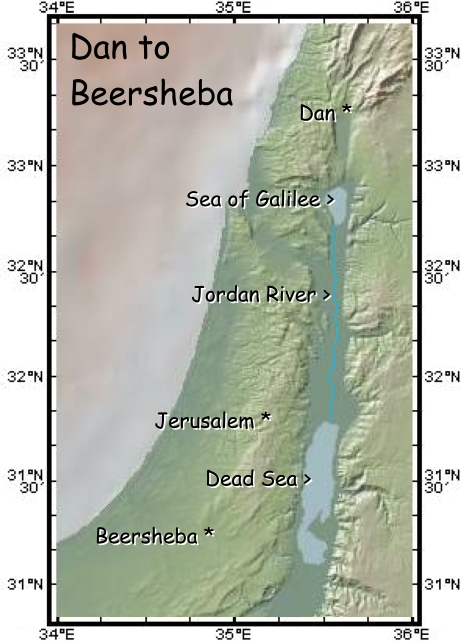
Several times in the OT, when people want to say "from one end of the country to the other," talking about Israel, they say "from Dan to Beersheba."
(I'm not advocating the views of the website linked in the previous phrase, but the map is easy to understand and illustrates this point, and the website quotes several of the texts using this phrase. For more on how this phrase has played a role in Zionist colonialism, there are many articles if you do a Google Scholar search for "from Dan to Beersheba" including, for example, this one.) 

"From Dan to Beersheba" might be like us saying, in Texas, "from Orange to El Paso." So, when Elijah went to Beersheba, he went all the way to the edge of the country and kept on going - out into the wilderness - before he finally collapsed under a tree.

What he does and says at that point might not seem to be reasonable, except when we recall that Elijah is a human being, and he is subject to stresses and emotions and the effects they have on mind and body.

After having experienced intense stress, violence, and a life-threatening situation (any of these by itself would do), most people's adrenaline wears off and they kind of crash - feeling depression and fatigue, seeing things in extreme terms and maybe wanting to die. That's exactly what happens to Elijah. He can't run any further, he feels worthless ("I'm no better than my ancestors") he asks God to kill him, and then he falls asleep.

I called Fr. Vernon to get some insight into what depression is and what it looks like. Since he is also Dr. Gotcher, he knows quite a bit about this topic. He said there are 2 kinds: situational depression (from something that has happened), also sometimes called "reactive" depression, and endogenous depression (chemically-based), sometimes called major depression or unipolar depression. Endo-genous means "generated from within." This type is still not completely understood.

Dr. Gotcher said it's very common for people to experience situational depression after a traumatic, especially a life-threatening event. He told a story, which he said I could share, of a time when he spun out on a wet road and went up an embankment, stopping just short of sliding out in front of oncoming cars on the highway. As soon as he caught his breath and realized the car was stopped, he started laughing and crying all at the same time.

I had a complication from surgery in 2005 that sent me into a downward spiral and close to death. About a week later, my first night outside of ICU, I remember looking out the window and seeing the lights of a plane coming into Houston Intercontinental - and I started crying. The world was still going on; I was still in it. I cried off and on the rest of the night.
Depression is one of the normal responses to traumatic stress, even though it may not feel normal compared to how you act most of the time.

People don't normally burst into tears at random moments, wish that they could die, and fall asleep at the drop of a hat - at least, not when they're not depressed. When someone is depressed, all those things are normal.

Just like people aren't normally covered with red dots... measles outbreak  ...unless they have chicken pox or measles, or have been bitten all over by bed bugs, in which case, being covered in red dots is exactly what you would expect.

Elijah was no different than you or me. Elijah, the great prophet, who performed miracles, called on God to send fire from heaven, was taken up into heaven in a flaming chariot - Elijah was a human being, not a super human being. After the big showdown, killing hundreds of people, and then having his life threatened, he became depressed; he was exhausted, he felt his life's work had been pointless, and he wanted to die.

I think it's important to know that, under certain circumstances, all kinds of things can be normal.

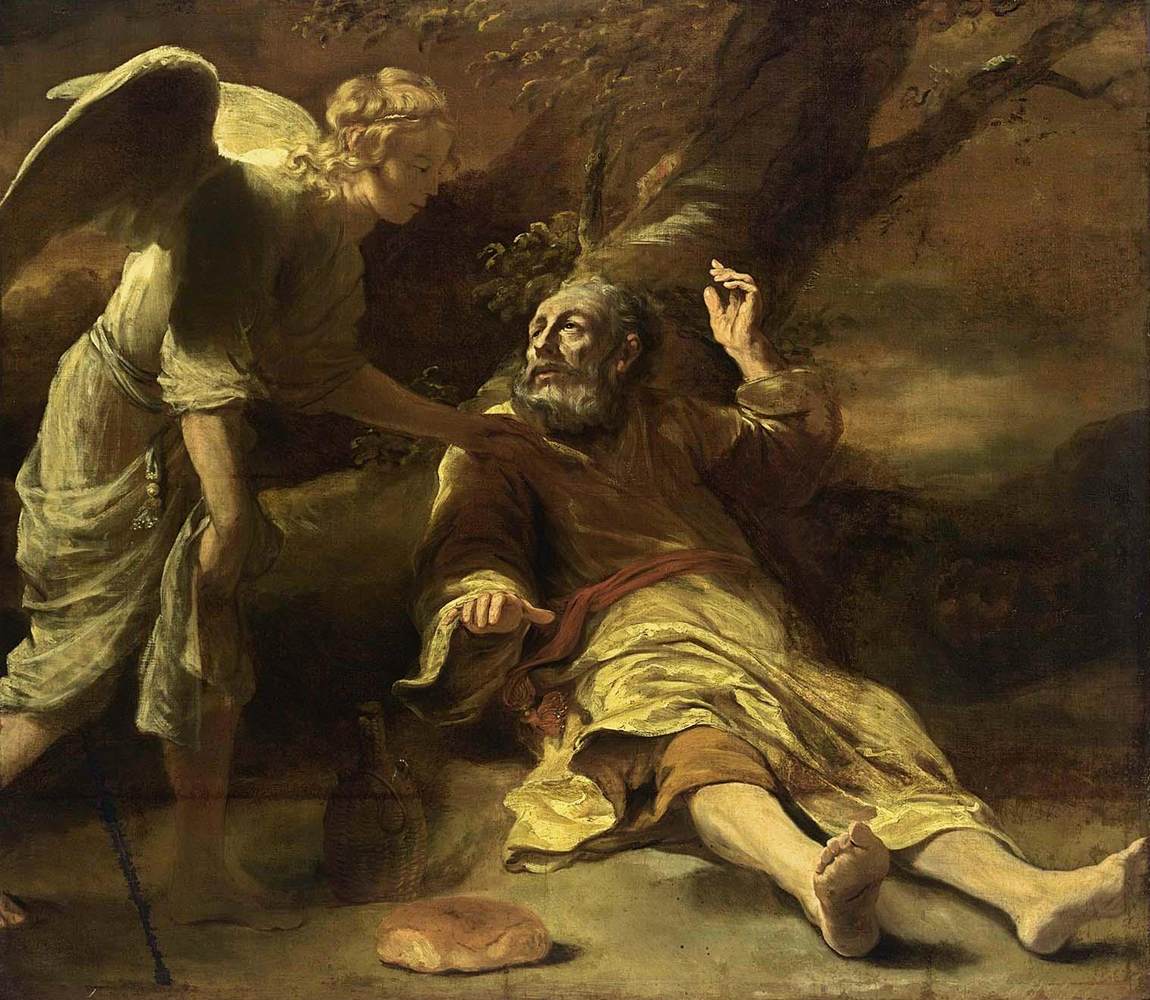
God's response is also instructive. God sends an angel who wakes Elijah up and gives him some food.
File:Ferdinand Bol - Elijah Fed by an Angel - WGA2360.jpg
Then he lets him sleep more.

God cares for Elijah and can provide a model for how we can help each other.

One woman on YouTube (whose video I will link as soon as I find it again) who has experienced depression said the thing that she thinks helps the most is to look after small things: fix a sandwich, wash clothes, bring some tea...


When my aunt came in to see me in the hospital the next morning and found me in tears, she helped me wash my hair. Later, when I got out of the hospital, they took me to their house to look after me for 2 months. The people of St. Mark's, my home parish, brought me food and did all sorts of other simple, thoughtful things. One person brought sweet pea blooms from her garden. Someone else brought me a prayer shawl. My brother and sister-in-law drove to Beaumont to stay with me for a week; they talked to me and took me for walks. A friend offered me a temporary job and helped me find an apartment. And it went on and on.

I said we are going to make soup.
I've started it off, Madelyn and Nancy and Fr. Gotcher have contributed, along with some people from the internet. Now, I'd like you to add something.

Here's what I'm asking you to do: Remember a time you experienced God's care for you like Elijah experienced under the broom tree, and write about it. How were you ministered to? Don't try to tell then entire story - just focus on one instance of God caring for you, in whatever form that took.
Then, read over what you've written and consider whether it's something you'd be willing to share. Feel free to edit until you have what you are comfortable sharing. I recommend leaving out names, unless you specifically want yourself identified. Then, add it into the comments section below.

Something to keep in mind: Being ministered to doesn't mean that, afterwards, everything was solved; the angel woke Elijah up from his rest under the broom tree and gave him more food so he could walk an even longer distance - and then climb a mountain.

It can be a helpful thing to hear other people's experiences. It can also be a helpful exercise to look back on your own story and see God caring for you so that you can offer thanks if you didn't at the time (or again - no danger of offering God too much gratitude). Your stories may offer reassurance of God's presence and hope for someone else.

I also recommend reading how Elijah's story continues in the rest of 1 Kings 19 once he reaches Mt. Horeb.

Sunday, January 15, 2012

Nathanael, Jesus, pumpkins, and the Gospel According to Randy Bachman

2nd Sunday after Epiphany, Year B
Lectionary Readings: 1 Samuel 3:1-10(11-20)   Psalm 139:1-5, 12-17   1 Corinthians 6:12-20
John 1:43-51


This morning I'm going to talk about Nathanael and Jesus,

and about Moses and God, the blue people from Avatar, and Bachman-Turner Overdrive.

And pumpkins.

The pumpkins are very important.

Let's start with the Gospel. Jesus decides to go to Galilee and he finds Philip and calls him to follow. Then Philip runs off to get Nathanael, who is not as enthusiastic about it. But as he's walking up, Jesus says "Here is an Israelite in whom there is no deceit" And Nathanael says "How do you know me?" Jesus says he saw Nathanael under the fig tree before Philip called him.
We don't know what that's about, but Nathanael does, and the fact that Jesus also knows convinces him that Jesus is the real deal; he knows what no one else but God would know. For him, it wasn't so much that seeing was believing - it was more being seen.

My nephew Jackson is a year and a half, and before bedtime, he likes somebody to read to him. For a while, his favorite book was God Knows All About Me by Kate Toms,

which is basically Psalm 139 for toddlers.

"From my fingers to my toes,
from my knees to my nose,
God knows all about me!"

There have been profound ways I've learned that God knows all about me, but then there are also little things that seem so insignificant that I never imagined he would care - and he knows those things too. Here's where the pumpkins come in.

I moved here from Beaumont at the very end of August; in early October, I went back to perform a wedding for one of my classmates from Lamar University. After the wedding, as I was driving back up here that Sunday night, I pulled into a gas station and suddenly noticed that there were pumpkins everywhere. I blinked a few times and then started laughing out loud. Why was that so funny? Let me give you the back story:

A couple of weeks before, I had visited St. Alban's in Arlington, where I met their deacon and their rector, who invited me to a meeting about campus ministry at UTA, inexplicably. I wasn't involved at UTA - I wasn't involved with St. Alban's - I wasn't even officially in the diocese yet - but for some reason, I was at this meeting, and they were talking about an idea for a pumpkin carving event, and for some reason, I opened my mouth and offered to bring pumpkins. As soon as I said it, I thought, "Why did I do that? Where am I going to find a bunch of pumpkins?"

The rest of the week, I was getting ready for the wedding, talking with Fr. Vernon (since I had just visited St. Stephen's for the 2nd time), and making plans to meet up with friends in Beaumont. And I would occasionally think about the pumpkins. I figured I could go to the grocery store, but I have been gradually getting more interested in trying to buy food grown locally when I can. I thought maybe I could go online and try to find someplace that sold local produce, but looking for pumpkins seemed kind of trivial. I didn't want to get sidetracked. I would worry about it after the wedding.

The wedding Saturday was great - so much fun - and Sunday I got to see a lot of good friends, had lunch with one of my deacon buddies. Then I started back. The drive was fine, but after about the fourth hour, I figured I should stop soon for gas. It was already dark. I was kind of in the middle of nowhere, but after a few miles, I could see some lights ahead, so I took the exit - the first building I came to was lit up with zig-zaggy neon lights in different colors, and I thought "this is probably not a gas station..." I was about to drive on past and get back on the highway when I looked left and saw a gas station on the other side of the highway, so I took the bridge over to it.
I was pulling in the driveway when it occurred to me that there were pumpkins stacked EVERYWHERE.


I blinked a few times and looked closely at the pumps; they said "Cooper Farms" - maybe this wasn't a gas station, either. I pulled up to a pump. Sure enough, you could get gas there.
You could also get pumpkins - LOTS of pumpkins.
Turns out, this was a creative marketing idea the farm had come up with: a gas station/point-of-sale for the produce. And the farm was just a few miles away. I laughed - I hadn't even been thinking about the pumpkins. Here they were, problem solved. I went inside and paid for my gas, along with a bunch of pumpkins. One of the guys who works on the farm helped me cram them in my trunk and on the floor of the back seat. Then I got in the car, put on my seatbelt, and started laughing - I laughed for the next few miles, and off and on the rest of the way home.

God KNEW me: he knew I wanted to buy a bunch of pumpkins, he knew I needed gas, and he knew where I could find both of those things right then, in the middle of nowhere, on a Sunday night. I hadn't asked him to help me with any of that; it wouldn't have occurred to me that such a solution even existed. And he didn't tell me; he just took me there, pulled his hands away from my eyes and said "Surprise!" and sat there with a grin on his face. Such a random thing - why would God bother helping me find pumpkins? Why would he care about that? And he seemed to smile at me and say, "Why wouldn't I?"

To God, all hearts are open, all desires known, and from him no secrets are hid

Lord, you have searched me out and known me: you know my sitting down and my rising up; you discern my thoughts from afar... my body was not hidden from you, while I was being made in secret and woven in the depths of the earth. Your eyes beheld my limbs, yet unfinished in the womb...

God knows all about me

If you have seen the movie Avatar,
What do the blue people say when they greet each other?

"I see you"
And what does it mean?
It means "I know you - I see who you are at the deepest level."

This greeting comes from isiZulu:

Sawubona - I see you
Yebo sawubona - yes, I see you, too

Another response in some places is: Ngikhona - I am here

It's similar to what people say in the Bible when God starts talking to them. They say "hineyni" and what it means is "Behold me" which is sort of like saying "look at me" or "see me" and it's usually translated into English as "Here I am."

It's how Moses responds to God speaking to him from the burning bush.
It's Isaiah's response to God's question "Whom shall we send, and who will go for us?" "Here I am, send me"
It's Mary responding to the annunciation, when the angel Gabriel told her the news about Jesus "Here am I, the servant of the Lord..."
And in our Old Testament reading for today - little Samuel hears someone calling his name, and his first response, even though he didn't know who he was responding to, was "Here I am, for you called me"

Which brings us back to Nathanael.
Jesus calls Philip, and Philip calls Nathanael to "come and see" what he's found.
as Nathanael's walking up, Jesus says "Here is truly an Israelite in whom there is no deceit" and Nathanael isn't sure what to make of that. "Where did you get to know me?"
Jesus tells him "I saw you under the fig tree before Philip called you."
Whatever it was Jesus was refering to about the fig tree, Nathanael knew, and that convinced him that Jesus knew him at the deepest level. Jesus said to Nathanael, "I see you," and Nathanael is suddenly able to respond to Jesus, "I see you, too."
In a 180-degree turn from his earlier attitude of "Can anything good come from Nazareth?" Nathanael says "Rabbi! You are the Son of God! You are the King of Israel!"

The next time God says, "I see you..."  try to respond like Moses, Isaiah, Samuel, and Mary - and say "Here I am"
Or you can respond like Nathanael and say, "Yes, I see you, too"

Which brings me finally to the Gospel according to Randy Bachman and a great interpretation of what Jesus said to Nathanael afterwards. "Do you believe because I told you I saw you under the fig tree? You will see greater things than these...."

In other words
Bbbaby - You ain't seen nothin' yet!

Monday, December 05, 2011

The beginning of the good news

I’ve got some good news!
The beginning of some good news at least... as Mark says “The beginning of the good news of Jesus Christ, the Son of God.”


Starting with what we hear in 2nd Peter:
The day of the Lord will come like a thief
•the heavens will pass away with a loud noise
•the elements will be dissolved with fire
•the earth and everything in it will be disclosed

And in Isaiah
All people are grass
their constancy is like the flower of the field
the grass withers, the flower fades
when the breath of the LORD blows upon it:

The earth is fragile; all people are grass. We learn this as species become extinct, as salt water begins to inundate and swallow small islands in the Pacific, as storms change our coastlines and earthquakes level our buildings. We learn this whenever we're startled by how easy it is for people to die. John F. Kennedy, the astronauts in the Challenger, the people in the Twin Towers, people you've known personally who died. It is always a little startling how fragile life is.

I know that I am like grass. I discovered this undeniably when I went through a medical crisis. I suffered a severe and unexpected complication after a procedure to stabilize a brain aneurysm (the aneurysm procedure went fine), and I came very close to death.

Many of you know that you are like grass. You've had medical scares. You've also seen how fragile the balance of your life is economically, emotionally, relationally. Some of you have been through divorce, family turmoil. Some of you have lost jobs or are experiencing uncertainty about your finances and future employment. You've experienced how things that seemed solid and unchanging can evaporate out from under you.
Nothing is too big to fail, really.

So how is any of this good news?

By itself, the fact that we are all grass is not good news, but there's more to it than that. That’s why it’s just the BEGINNING of the good news.

Let's hear what Mark has to say.
John the Baptist comes preaching baptism for repentance of sins
Message: Repent, Make straight the way of the Lord
"Make straight the way of the Lord" implied the following:
- the king is coming to visit
- literally, you should fix the road so he'll have smooth travel (fill in the potholes, etc)
The beginning of the good news in Mark was a startling voice calling people to acknowledge their failings and go in a different direction, preparing for something better.

John’s message was some difficult news. Road work - literally or figuratively - is hard. Whether you actually fill in potholes and straighten out the road shoulders or you start filling in empty places and smoothing over estrangements and other things we've messed up in our lives, either way, it’s hard work. The types of effort it takes to repair and turn a life around are not easy - repentance, reconciliation, discipline - and a trusting openness to God. A lot of people give up on it after they’ve barely started.
As GK Chesterton said, "The Christian ideal has not been tried and found wanting; it's been found difficult and left untried."

Parts of our culture really don't like difficulty, because it can result in failure, which shows up our weaknesses. We don't want to admit to anyone, least of all ourselves, that we HAVE any weaknesses. Other parts of our culture like to embrace difficulty, though in very controlled environments, for a similar purpose – to showcase strength in order to rebut any charge of weakness. Marathons, triathlons, Iron Man events, multi-day bike races, and all kinds of strenuous and challenging physical feats have become very popular.
But our strength is very relative.

I would not be much of a match for a bear or a shark, for instance, much less an asteroid. Even in relation to other people, it's still not equal. I'm five feet tall, so unless I were playing basketball with second graders, I would not be much of a force to reckon with. And it's not only in external conflicts that our weaknesses appear. Some of the most serious are inside our own bodies. Consider your brain - physiologically. Very powerful - and VERY delicate. Thinking about the aneurysm I had - the weak wall of the artery that had ballooned out was maybe a fraction of a millimeter thick - and if that unimaginably thin tissue were to tear, my brain would react so strongly to coming in contact with the slight acidity of my blood that I would most likely die or become profoundly disabled.

And it's not just our bodies that are weak. Our relationships are fragile and require constant tending and strengthening; our emotions are difficult to understand, much less control; our minds are easily confused and disturbed; our wills are fairly easy to corrupt and require consistent training and scrutiny.
The fact is we are human.
Weakness is our PRIMARY reality, in every area of our lives.

And that's the good news!

Because God's strength is made perfect in weakness.
God's strength perfectly complements our weakness.
Our weakness showcases God's strength.

It's not the type of strength you may be used to - the strength of a predator who takes from the weak to increase its own strength - a lion snatching a sheep. This is the strength of the shepherd who fights off the lion. Trust that kind of strength.

God's strength rises to the challenge of our weakness to make both of us stronger. Think of the kid in the movie The Sandlot, who summons all his skill, more than was usually asked of him, and hits the ball right into Small's glove - so he'll have some confidence and start to get better.

Not only is God good; he's so good, he makes it possible for us to get better.

So when you pray, when you open the door of your weakness to God, and when you come to receive communion and healing, don't just look for comfort; look for strength.
And then, start looking for ways you can rise to the challenge of others' weaknesses, and in God's strength, begin to strengthen them.

The beginning of the good news is that we are weak.
The rest of the good news is that he is strong.

Sunday, November 13, 2011

Talents

Readings for the 22nd Sunday after Pentecost, Year A

Almighty God, whose loving hand has given us all that we possess: Grant us grace that we may honor you with our substance, and, remembering the account which we must one day give, may be faithful stewards of your bounty, through Jesus Christ our Lord.
Amen.

So the kingdom of heaven will be like this:

a master goes on a journey and entrusts his property to his slaves - he gives the first guy five talents, he gives the second guy two talents, and he gives the third guy one talent... to each according to his abilities

Now, when we say a talent, we mean something you're good at, like singing or playing basketball, or learning other languages, but that's not what it meant back then. Originally, a talent was an amount of money. So the master gave his slaves different amounts of money, based on what he felt they could handle, and then left to go on a trip. Two of them traded the talents and made twice as much; one of them buried the talent, so that the amount was the same when he gave it back. If you want to know basically how much he gave them (and how much they gave back), a talent is roughly 15 years’ wages for a day laborer. You can get a pencil or pull up the calculator on your phone and figure out what that might roughly be.

Assuming current minimum wage, one talent = (approximately)

$7.25/hour x 40 hours/week x 52 weeks/year x 15 years

Write it down; we’ll come back to it later.

So, in the story, the guy with the five talents and the guy with the two talents are smart - they trade for twice as much. It reminds me of this poem by Shel Silverstein...


Another story of trading up, which you may have heard about, involves a guy from Canada named Kyle MacDonald, who wanted to move into a house and started trading up towards that goal by offering one red paperclip on Craigslist. He writes
On July 12, 2005 I posted a picture of a red paperclip on my blog and in the barter section of craigslist and asked if anyone wanted to make a trade for something bigger or better. A few days later I traded the paperclip for a pen shaped like a fish. Then I traded the pen for a doorknob. And so on, each time trading for something bigger or better. Once all the dust settled, I'd made 14 trades and wound up with a house located at 503 Main Street in Kipling Saskatchewan.

 And that's starting with a paperclip.

What if you started with...  a talent?
Remember how much one talent is?

($7.25  x  40  x  52  x  15...)

So the guy with one talent had something like a quarter of a million dollars, and the guy with two had almost half a million, and the guy with five had over a million! That's a lot of somebody else's money to be responsible for; I sure wouldn't want to lose it.
That was the third guy's approach; he played it safe, not wanting to risk losing any of the money. But the first two guys were responsible for handling even more of their master's money, and they weren't scared at all - immediately went out and risked it in trading.

FEAR is one difference between the first two guys and the third guy. As he says when the Master returns,
Master, I knew you were a harsh man, reaping where you did not sow, and gathering where you did not scatter seed, so I was afraid, and I went and hid your talent in the ground. Here you have what is yours.
Another difference between the guy who buried his master's money and the other two who risked it is TRUST.

The first two guys viewed the money their master gave them as an opportunity because they trusted his confidence in their ability to handle it. In taking the money and trading with it, they accepted the responsibility of sharing with their master in the household's business. And when he returned, he invited them to share in his joy.

The third guy feared and distrusted the master. When the master gave him more money than he felt qualified to manage, this guy viewed it as a setup - a test designed to trap him - so he buried the quarter million dollars in the ground. Burying the talent was not to keep the money safe for his master so much as to keep himself safe from the master's invitation into shared responsibility. As he says on returning the money "Here you have what is yours." He never accepted the master's trust in him in the first place. "Here's your stuff - I didn't mess with any of it. I don't even know why you gave it to me in the first place. It's none of my business. I just work here."

The master gets really angry with him. His no-risk = no-failure strategy misses the whole point of the exercise. And he doesn’t account for opportunity loss. It's like taking only classes that are way easy for you so your GPA doesn't go down. Or like going up to bat and never swinging at a pitch because you don't want to run the bases and maybe have to slide...and get dirty, or possibly even hurt.

From this parable, I'm beginning to get the feeling that the point of the life we've been given is to get in the game, not to finish with a clean uniform. While we're here, we should play hard, go all out, even if we get grass-stained and dirty in the process. Even if we get hurt; even if we fail. And EVEN - though this is the scariest of all I think - EVEN if we succeed... and God gives us more responsibility to share with him in the work of his kingdom.

The kingdom of heaven will be like this: a man, going on a journey, summoned his slaves and entrusted his property to them...

Don't be scared of how much God has entrusted you with.
Ask yourself (like Kyle MacDonald's dad asked him when he thought of giving up the red paperclip idea)...
What would you do if you weren't afraid?
As those famous theologians, The Goo Goo Dolls, wrote:

The end of fear is where we begin.

Amen