God, you yourself are a community: Father, Son and Holy Spirit; help us to model our life together after your love in the Trinity.
Today is Trinity Sunday – and tomorrow is Memorial Day.
Do you remember what we’re remembering on Memorial Day? Got an email this week from several people with a cartoon by Joe Heller showing a guy in a baseball hat, sunglasses and an apron leaning over his barbecue grill - “Hotdogs, Hamburgers, Bratwurst… Is there anything I forgot?” while in the smoke above the grill, you can see the faces of soldiers who sacrificed their lives, part of a bigger picture that’s obscured when we forget our history.

When we don’t understand or remember the bigger story and what others have given for our sake, we may treat what we’ve received lightly or even throw it away. When we don’t realize our part in the bigger story, the only story that matters is our own, and by itself, it’s very small.
As part of St. John’s, we are part of the Episcopal Church, and the Anglican Communion, and the Church universal from the past and into the future. It’s important to remember the bigger story we’re part of.
For Christians, every Sunday is a Memorial Day – “we remember his death; we proclaim his resurrection…” Everything we do in a Sunday service - every part of the liturgy, every action, every word, every piece of art on the walls, every sound, every taste - is designed to help us remember, to ingrain the story of who we are and who God is into the fabric of our being. Our language resonates with the different tones of Father, Son and Holy Spirit and our understanding of those relationships.
Glory to you, Lord Christ...The Trinity forms the basis and model for the community of the Church and for every relationship we participate in: family, church, school, work, city, nation… We learn best from the Trinity how to be part of a community, part of God’s bigger picture.
Our Father, who art in heaven…thy kingdom come...Cleanse the thoughts of our hearts by the inspiration of your Holy Spirit…We believe in one God…
What is the Trinity? There are many doctrinal formulations and descriptions, many symbols and analogies to try and help people remember this central understanding of our faith in God. Take a look at the insert in your bulletin. The historical documents of our church say that the Trinity is “one God: Father, Son and Holy Spirit” (BCP - Catechism, p. 852)“Three Persons, of one substance…” (Articles of Religion, Article I, BCP p. 867)
If you take a look sometime at the Athanasian creed, it gets very involved.
But words don’t really capture the relationship of the members of the Trinity. People have tried with images also. The inside of your insert explains some of this visual symbolic vocabulary.
St. Patrick’s famous shamrock,
the Celtic triquetra knot,
various combinations of circles and triangles, conveying that the Trinity has both “one-ness” and “three-ness.”
You can also combine symbols of the Father, the Son and the Spirit with these to show distinctions among the members.
 More complex designs combine words and images show that while the three Persons of the Trinity are all God, they have distinct identities; they are not the same as each other. The Shield of the Trinity is based on the Athanasian Creed - The Trinity window in Trinity Episcopal Church in Galveston is a circular version of the shield diagram.
But symbols can’t capture the identities of the members of the Trinity either. As Sandra Schneiders, a Roman Catholic nun, observed, “God is more than two men and a bird.” The Trinity is more than words or symbols can convey, but symbols can help us focus on important aspects of God’s character. These interlocking circles here on the front of the pulpit, for instance, show that the members of the Trinity are equal, each whole, and each inextricably joined to the others. How could it inform our life together if we understood and lived the truth that we are all equal, whole and inextricably joined to each other and to God?
On the back of your insert is a much more complex and nuanced representation of the Trinity – Rublev’s icon. Here, three people are presented, not just shapes or symbols or words, and we can read from their expressions and gestures something about their relationships.
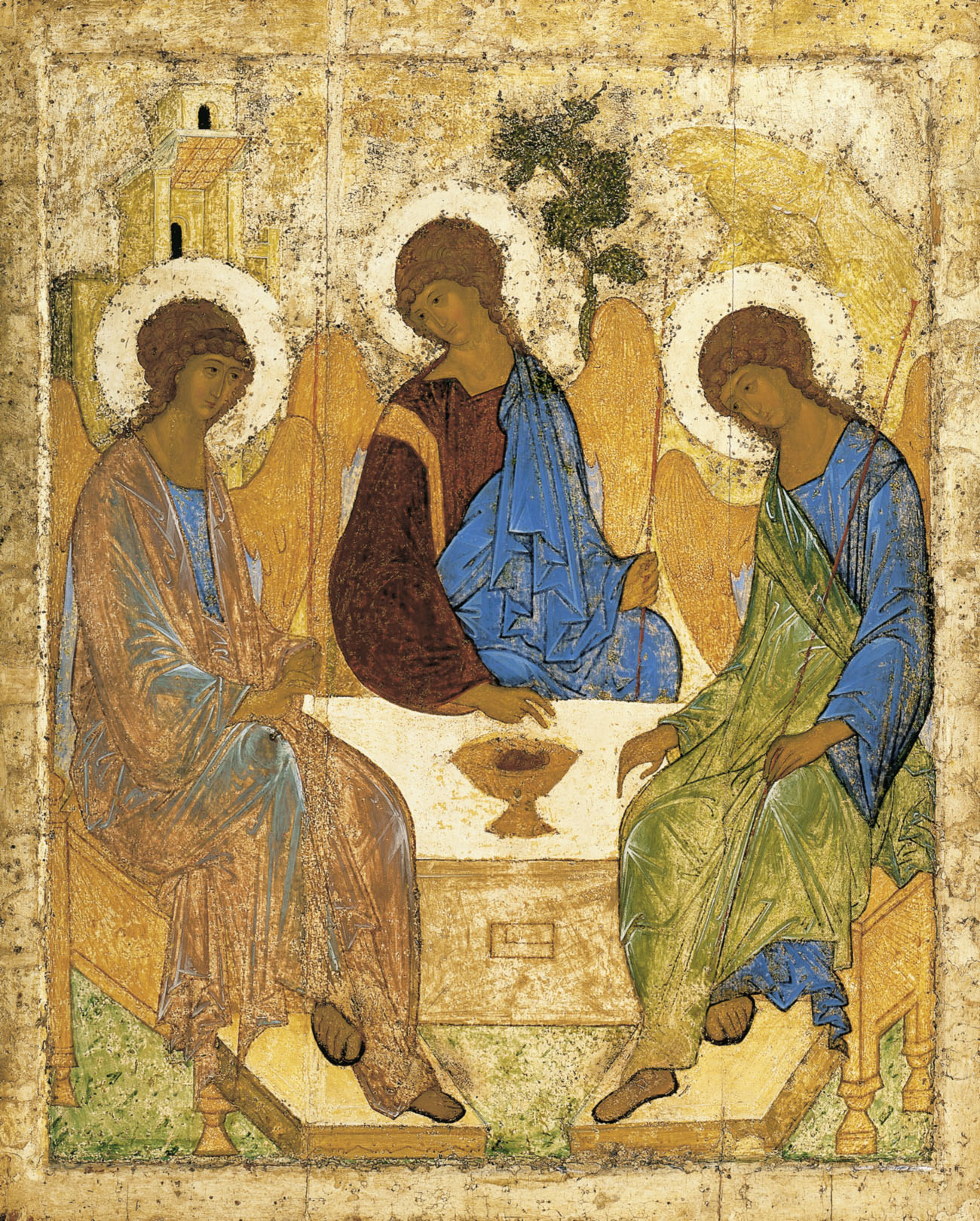
One thing to notice is all the faces are the same, because all are God. As Jesus said to Philip in last week's Gospel when Philip asked to see the Father… “Have I been with you all this time, Philip, and you still do not know me? Whoever has seen me has seen the Father.” (Jn 14:8-9)
The angels are all looking at each other, and their wings overlap each other, showing their close relationship, and their attentiveness to each other. To be in relationship, then, means not only that our lives intersect and overlap at points, but we need to consciously pay attention to each other, to see and hear one another.
The three are seated around a table, with food; their relationship isn’t only talk, but includes hospitality and enjoyment. And there are four sides to the table but only three guests; the open seat is closest to us, and we are invited to join in. So while we love each other and consciously work to sustain our relationships, we should also always look to welcome new members into our community through hospitality.
(Here is one in-depth analysis of the imagery, and here is a reflection on the icon, and another reflection)
Bishop Ian Douglas of Connecticut said,
The Trinitarian God is a God whose very nature is one of relationality, whose very essence is defined by relationship. Our Trinitarian God is thus a God of community, a divine community of love.The Rev. Joyce Wilkinson commented on this thought that
We can’t be a Christian alone; even our God is a community.In a different analogy, the relationship of the Trinity was described by St. John of Damascus in the 8th century as a three-person dance (his word was perichoresis), requiring each one to pay close attention to the others in order to move together gracefully. Let’s see them try that in Dancing with the Stars!
Even when you’re paying attention and trying to move together, it can be tricky; imagine if you were to try dancing without paying attention to who you’re dancing with, or even ignoring them… You’re going to step on each other and trip or go opposite ways and maybe yank each other over – any of which will look very un-graceful.
Sometimes, the church is very ungraceful in the way it dances together. But God is not.
The Rev. Joyce and I were talking about the Trinity at Starbucks Thursday night, and afterwards she sent me an email – she had been thinking more about this metaphor of the dance, and she sent me something she read from the Rev. Charles Hoffacker:
The Trinity is unending, joyous dance, yet the wonder is that the circle breaks open,… inviting us in…Amazingly, God wants us as dance partners, and he doesn’t seem to mind that we are ungraceful, because he loves us. I’m a terrible dancer, though ironically, I love the idea of dancing and would like to learn to do it well, but I always feel nervous about agreeing to dance with someone because I’m worried about being so bad at it and getting embarrassed. But if I trust the person, I can relax and try to follow them, and I end up enjoying the dance. I think it’s like that with God; once we start to trust him and pay attention to where he’s going and try to go with him, we begin to enjoy the dance and worry less whether every step is perfect.
There are different kinds of fear that keep us away from things. One is fear of actual danger. Fr. John talked last week about Pentecost, and how the Holy Spirit is like wind and fire – dangerous and unpredictable. So it’s reasonable to be afraid of allowing the Spirit free reign in your life. It could be dangerous. But then again, there’s courage, and courage is a response to fear when you’re trusting something more certain – and it’s more certain that God loves us. Not that it’s a guarantee nothing scary will happen. It might - God might dip you nearly to the floor – or swing you up over his head – in fact, we ought probably to expect something like that, because he’s kind of crazy sometimes. But the thing is, he won’t drop you.
If the dance metaphor doesn’t work for you, you might also think of this life with the Trinity as cultivating a garden, like in The Shack, where the Holy Spirit is planting and pruning and moving things around in your life. The next 24 weeks, in the long, green growing season after Pentecost, something ought to start sprouting and producing some fruit in you. Don’t be surprised. The Church does its best to make sure the Word gets planted every week (and every day, too).
Then, sometimes when people or events in your life poke holes in your heart, God takes that opportunity to push the seeds further down – and often some manure gets thrown in, too. Take heart...
This is a prime growing environment!
So actually, if something doesn’t grow in you these next few months, that should be the more surprising and concerning thing – and maybe you will want to think about how to rehabilitate your soil...
During this long, green growing season, tend your garden and see what God’s been planting as it starts to come up and bloom.
Amen.