Showing posts with label hospitality. Show all posts

Sunday, August 29, 2010

Homework...

Gospel Reading: Luke 14:1,7-14

Not for a place of honor did your Son come among us, O god of the lowly, but to invite to the wedding feast the poor, the crippled, the blind and the lame. Let such humility grace our table and lead us to renounce the quest for power and privilege. … Amen.
(From Prayers for Sunday and Seasons, Year C, Peter J. Scagnelli, LTP, 1992.)

It seems there is a common theme lately in sermons to this community. A lot of them seem to be focusing on breaking attachments to money and power and other things that serve as pseudo-security in place of God.

Here is the same topic again today – in Jeremiah, the prophet talks about the people forgetting and turning their back on all God did for them, his continual provision and faithfulness: rescuing them from Egypt, leading them through the wilderness – through a land no one survives in – and bringing them into a land where there is plenty. Instead of remembering that they owe all their current prosperity to God, they start attributing it to themselves and to other gods. Through Jeremiah, God laments, “My people have changed their glory for something that does not profit… they have forsaken me, the fountain of living water, and dug out cisterns for themselves, cracked cisterns that can hold no water.”

In the Psalm, we hear again God’s promise to take care of his people’s needs, as he has continually done in the past, and his wish that they would accept what he wants to give them.

I am the LORD your God, who brought you out of the land of Egypt and said,
"Open your mouth wide, and I will fill it." … O that my people would listen to me.
Hebrews is very straightforward in its advice.
Keep your lives free from the love of money and be content with what you have. Do not neglect to do good and to share what you have.

I’m not sure why this keeps being the theme of sermons here. Maybe it’s something this community particularly needs to hear – or maybe it’s just a topic everybody needs to have reiterated. Probably both. Are you aware if it’s sinking in for you?

Money is not security; God is security.
Money is not ultimately of any value; God is of ultimate value.
Money may or may not even get you daily bread; God provides for your every need.

Money is only useful if you can trade it for what you need or want, but if what you need isn’t available, money won’t get it for you, and if the person who has what you need doesn’t want money for it, there again, money is not use. We’ve seen also that money can very easily and very quickly lose value and even become completely worthless. And it’s of no use at all in obtaining things of really great value.

“Will you be my friend? I’ll give you a hundred dollars…”
“Will you drop the charges against me? I’ll give you a hundred dollars…”
“Will you marry me? I’ll give you a hundred dollars…”
“I want to be a senator. I’ll give you a hundred dollars…”
“Can I have an indulgence to erase my sins? I’ll give you a hundred dollars…”

When people try to trade money for these things, it becomes a scandal – money, in these situations, actually reduces the value of what it’s traded for. Inappropriate use of money in these areas fosters disillusionment: with the political system, with the church, with relationships… it cheapens them, it makes them seem untrustworthy. Why? Because these things are based on a higher value than money.

For some things that have really ultimate value, money is not even a scandal, it’s just a joke.

“God, will you let me in? I’ll give you a hundred dollars…”

What does God have to do with money? Does God buy things? He owns the cattle on a thousand hills – he doesn’t need anything from us. It’s the other way around, he gives us everything. What do we have that we have not been given?

But still, it’s habit to hang onto our things, our abilities, our relationships, even our lives, as though they are ours and not God’s. And we try to get more by taking from each other. An outward representation of that is what Jesus saw at a party: people schmoosing and trying to network and make connections to power and wealth to get up the ladder, trying to sit closest to the host of the party, to be seen as more important. Parties are often still like this – you’ve got some folks trying to sit with or talk to certain other folks – the kids who are more popular, the bosses who are more powerful, the stars who are bigger celebrities. At the same time, people are trying to avoid and get away from those they feel are lower than themselves or might somehow pull them down.

But Jesus says we’re not to be like that – from either side. Neither the brown-nosers nor the snobs.

As one commentator, David Lose, noted, Jesus is not just being Miss Manners when he talks to people about how to act at parties – and who to invite. This business about who sits closest to the host is about pecking order, but Jesus says forget the pecking order – it’s the other way around. Don’t try to sit in the highest seat; sit in the lowest. Don’t try to be the king; be everyone’s servant.

And if you’re the one who’s throwing the party, don’t invite people you want to impress, people you think can help you advance your career, your station in life. You scratch their back and they’ll scratch yours. No, don’t do that – that doesn’t earn you any favor with God, because there’s nothing hospitable or generous about it; it’s a calculated investment, but whatever you get back is all the benefit there is to that kind of transaction. It doesn’t win you any points in heaven.

No, if you want to invest in something truly valuable, try to do something to win God’s favor – as Jesus advises. Do something good for someone who can’t do anything for you. Invite people to your party who can’t even bring the bean dip.

Since this money and economy and giving topic seems to keep coming up, possibly it’s something we need to learn better. In school, when a concept is difficult to grasp with just a lecture, the teacher gives you some homework to practice…

I think that’s a good idea to implement in church. Lots of times, people just come to church and listen to the lecture, and I don’t know how much application of the learning takes place afterwards. I guess that’s fine if you’re just auditing, but really, why even audit a course unless you actually want to learn the material?

So, I’m giving a homework assignment. Now, I’m not the teacher; you won’t turn it in to me. Jesus is the teacher; I’m just subbing today. But this is some of the material he left for us to work on.

Monday, May 31, 2010

Trinity

Readings for Trinity Sunday, Year C          Illustrated bulletin insert


God, you yourself are a community: Father, Son and Holy Spirit; help us to model our life together after your love in the Trinity.

Today is Trinity Sunday – and tomorrow is Memorial Day.
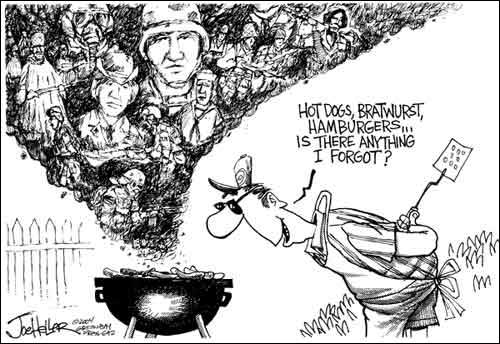
Do you remember what we’re remembering on Memorial Day? Got an email this week from several people with a cartoon by Joe Heller showing a guy in a baseball hat, sunglasses and an apron leaning over his barbecue grill - “Hotdogs, Hamburgers, Bratwurst… Is there anything I forgot?” while in the smoke above the grill, you can see the faces of soldiers who sacrificed their lives, part of a bigger picture that’s obscured when we forget our history.

When we don’t understand or remember the bigger story and what others have given for our sake, we may treat what we’ve received lightly or even throw it away. When we don’t realize our part in the bigger story, the only story that matters is our own, and by itself, it’s very small.

As part of St. John’s, we are part of the Episcopal Church, and the Anglican Communion, and the Church universal from the past and into the future. It’s important to remember the bigger story we’re part of.
For Christians, every Sunday is a Memorial Day – “we remember his death; we proclaim his resurrection…” Everything we do in a Sunday service - every part of the liturgy, every action, every word, every piece of art on the walls, every sound, every taste - is designed to help us remember, to ingrain the story of who we are and who God is into the fabric of our being. Our language resonates with the different tones of Father, Son and Holy Spirit and our understanding of those relationships.

Glory to you, Lord Christ...
Our Father, who art in heaven…thy kingdom come...
Cleanse the thoughts of our hearts by the inspiration of your Holy Spirit…
We believe in one God…

The Trinity forms the basis and model for the community of the Church and for every relationship we participate in: family, church, school, work, city, nation… We learn best from the Trinity how to be part of a community, part of God’s bigger picture.

What is the Trinity? There are many doctrinal formulations and descriptions, many symbols and analogies to try and help people remember this central understanding of our faith in God. Take a look at the insert in your bulletin. The historical documents of our church say that the Trinity is “one God: Father, Son and Holy Spirit” (BCP - Catechism, p. 852)“Three Persons, of one substance…” (Articles of Religion, Article I, BCP p. 867)
 If you take a look sometime at the Athanasian creed, it gets very involved.
(More info on the history, etc. of the Athanasian Creed.)

But words don’t really capture the relationship of the members of the Trinity. People have tried with images also. The inside of your insert explains some of this visual symbolic vocabulary.
St. Patrick’s famous shamrock,
the Celtic triquetra knot,
various combinations of circles and triangles, conveying that the Trinity has both “one-ness” and “three-ness.”
You can also combine symbols of the Father, the Son and the Spirit with these to show distinctions among the members.

More complex designs combine words and images show that while the three Persons of the Trinity are all God, they have distinct identities; they are not the same as each other. The Shield of the Trinity is based on the Athanasian Creed - The Trinity window in Trinity Episcopal Church in Galveston is a circular version of the shield diagram.

But symbols can’t capture the identities of the members of the Trinity either. As Sandra Schneiders, a Roman Catholic nun, observed, “God is more than two men and a bird.” The Trinity is more than words or symbols can convey, but symbols can help us focus on important aspects of God’s character. These interlocking circles here on the front of the pulpit, for instance, show that the members of the Trinity are equal, each whole, and each inextricably joined to the others. How could it inform our life together if we understood and lived the truth that we are all equal, whole and inextricably joined to each other and to God?

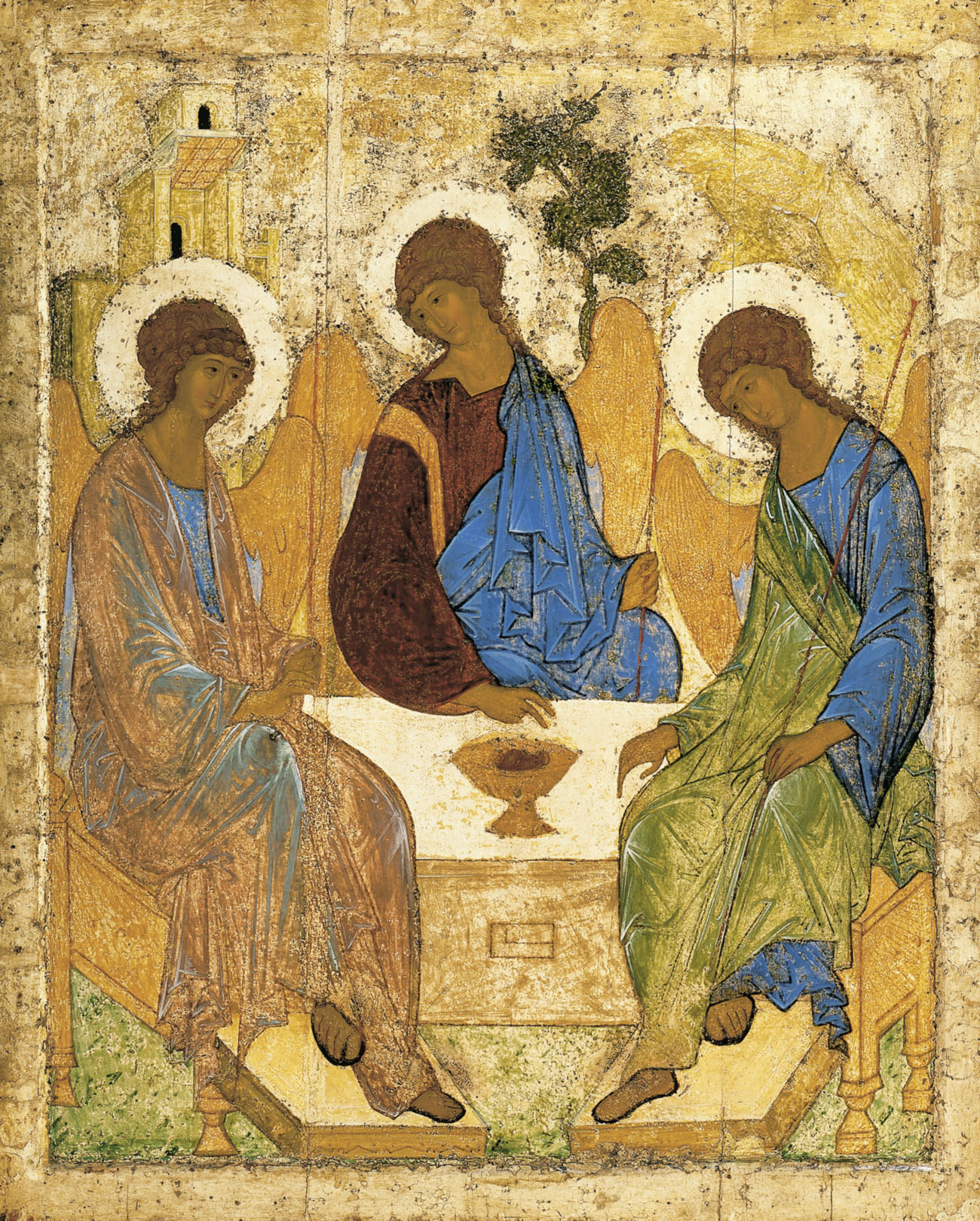
On the back of your insert is a much more complex and nuanced representation of the Trinity – Rublev’s icon. Here, three people are presented, not just shapes or symbols or words, and we can read from their expressions and gestures something about their relationships.

One thing to notice is all the faces are the same, because all are God. As Jesus said to Philip in last week's Gospel when Philip asked to see the Father… “Have I been with you all this time, Philip, and you still do not know me? Whoever has seen me has seen the Father.” (Jn 14:8-9)

The angels are all looking at each other, and their wings overlap each other, showing their close relationship, and their attentiveness to each other. To be in relationship, then, means not only that our lives intersect and overlap at points, but we need to consciously pay attention to each other, to see and hear one another.

The three are seated around a table, with food; their relationship isn’t only talk, but includes hospitality and enjoyment. And there are four sides to the table but only three guests; the open seat is closest to us, and we are invited to join in. So while we love each other and consciously work to sustain our relationships, we should also always look to welcome new members into our community through hospitality.
(Here is one in-depth analysis of the imagery, and here is a reflection on the icon, and another reflection)

Bishop Ian Douglas of Connecticut said,
The Trinitarian God is a God whose very nature is one of relationality, whose very essence is defined by relationship. Our Trinitarian God is thus a God of community, a divine community of love.
The Rev. Joyce Wilkinson commented on this thought that
We can’t be a Christian alone; even our God is a community.
In a different analogy, the relationship of the Trinity was described by St. John of Damascus in the 8th century as a three-person dance (his word was perichoresis), requiring each one to pay close attention to the others in order to move together gracefully. Let’s see them try that in Dancing with the Stars!
Even when you’re paying attention and trying to move together, it can be tricky; imagine if you were to try dancing without paying attention to who you’re dancing with, or even ignoring them… You’re going to step on each other and trip or go opposite ways and maybe yank each other over – any of which will look very un-graceful.

Sometimes, the church is very ungraceful in the way it dances together. But God is not.

The Rev. Joyce and I were talking about the Trinity at Starbucks Thursday night, and afterwards she sent me an email – she had been thinking more about this metaphor of the dance, and she sent me something she read from the Rev. Charles Hoffacker:
The Trinity is unending, joyous dance, yet the wonder is that the circle breaks open,… inviting us in…
Amazingly, God wants us as dance partners, and he doesn’t seem to mind that we are ungraceful, because he loves us. I’m a terrible dancer, though ironically, I love the idea of dancing and would like to learn to do it well, but I always feel nervous about agreeing to dance with someone because I’m worried about being so bad at it and getting embarrassed. But if I trust the person, I can relax and try to follow them, and I end up enjoying the dance. I think it’s like that with God; once we start to trust him and pay attention to where he’s going and try to go with him, we begin to enjoy the dance and worry less whether every step is perfect.

There are different kinds of fear that keep us away from things. One is fear of actual danger. Fr. John talked last week about Pentecost, and how the Holy Spirit is like wind and fire – dangerous and unpredictable. So it’s reasonable to be afraid of allowing the Spirit free reign in your life. It could be dangerous. But then again, there’s courage, and courage is a response to fear when you’re trusting something more certain – and it’s more certain that God loves us. Not that it’s a guarantee nothing scary will happen. It might - God might dip you nearly to the floor – or swing you up over his head – in fact, we ought probably to expect something like that, because he’s kind of crazy sometimes. But the thing is, he won’t drop you.

If the dance metaphor doesn’t work for you, you might also think of this life with the Trinity as cultivating a garden, like in The Shack, where the Holy Spirit is planting and pruning and moving things around in your life. The next 24 weeks, in the long, green growing season after Pentecost, something ought to start sprouting and producing some fruit in you. Don’t be surprised. The Church does its best to make sure the Word gets planted every week (and every day, too).
Then, sometimes when people or events in your life poke holes in your heart, God takes that opportunity to push the seeds further down – and often some manure gets thrown in, too. Take heart...
This is a prime growing environment!
So actually, if something doesn’t grow in you these next few months, that should be the more surprising and concerning thing – and maybe you will want to think about how to rehabilitate your soil...

During this long, green growing season, tend your garden and see what God’s been planting as it starts to come up and bloom.

Amen.