God, thank you for showing us, through Elijah's experience under the broom tree, that in returning and rest we will be saved.
Today, we are going to make some stone soup - several people are contributing, including you, I hope.
Here's what happened on Sunday:
Nancy and Madelyn demonstrated the Old Testament reading by acting out the story of Elijah under the broom tree, ministered to by an angel. If you weren't there, you missed out! They did a great job :-)
Then I discussed it, focusing on Elijah's emotional state, which we can recognize as depression, and here's what I said, basically, starting out with THE CONTEXT of the reading from 1 Kings.
You may know the story about Elijah having a showdown with the prophets of Baal on Mt. Carmel about who was really God: Yahweh or Baal.
The contest was that the prophets of Baal would pray to Baal to light the fire under their sacrifice, and Elijah would pray to God to light the fire under his sacrifice. Whichever god answered with fire would win, and the people would worship that god.
The prophets of Baal went first; they danced around the altar, leaping, shouting, and cutting themselves, until eventually they collapsed from exhaustion, but...
no fire - nothing.

Then he prayed:
O Lord, God of Abraham, Isaac, and Israel, let it be known this day that you are God in Israel, that I am your servant, and that I have done all these things at your bidding. Answer me, O Lord, answer me, so that this people may know that you, O Lord, are God, and that you have turned their hearts back.
And immediately, FIRE came down from heaven:
Then the fire of the Lord fell and consumed the burnt offering, the wood, the stones, and the dust, and even licked up the water that was in the trench. When all the people saw it, they fell on their faces and said, “The Lord indeed is God; the Lord indeed is God.” Elijah said to them, “Seize the prophets of Baal; do not let one of them escape.” Then they seized them; and Elijah brought them down to the Wadi Kishon, and killed them there.

So, God won; Elijah and the people grabbed and killed all the prophets of Baal. Jezebel, the queen, was incensed when she heard about it.
She sent a messenger to tell him this:
“So may the gods do to me, and more also, if I do not make your life like the life of one of them by this time tomorrow.”
She was putting out a hit on him, sending out her assassins. And coming from Jezebel, you could be sure it was no idle threat.
But, considering that Elijah had just witnessed God sending fire from heaven, you would think he might just laugh at a threat like that, knowing what a powerful God he was serving.
No, he was terrified. He took off - he went all the way to Beersheba, which is far.
 Several times in the OT, when people want to say "from one end of the country to the other," talking about Israel, they say "from Dan to Beersheba."
(I'm not advocating the views of the website linked in the previous phrase, but the map is easy to understand and illustrates this point, and the website quotes several of the texts using this phrase. For more on how this phrase has played a role in Zionist colonialism, there are many articles if you do a Google Scholar search for "from Dan to Beersheba" including, for example, this one.)
"From Dan to Beersheba" might be like us saying, in Texas, "from Orange to El Paso." So, when Elijah went to Beersheba, he went all the way to the edge of the country and kept on going - out into the wilderness - before he finally collapsed under a tree.
What he does and says at that point might not seem to be reasonable, except when we recall that Elijah is a human being, and he is subject to stresses and emotions and the effects they have on mind and body.
After having experienced intense stress, violence, and a life-threatening situation (any of these by itself would do), most people's adrenaline wears off and they kind of crash - feeling depression and fatigue, seeing things in extreme terms and maybe wanting to die. That's exactly what happens to Elijah. He can't run any further, he feels worthless ("I'm no better than my ancestors") he asks God to kill him, and then he falls asleep.
I called Fr. Vernon to get some insight into what depression is and what it looks like. Since he is also Dr. Gotcher, he knows quite a bit about this topic. He said there are 2 kinds: situational depression (from something that has happened), also sometimes called "reactive" depression, and endogenous depression (chemically-based), sometimes called major depression or unipolar depression. Endo-genous means "generated from within." This type is still not completely understood.
Dr. Gotcher said it's very common for people to experience situational depression after a traumatic, especially a life-threatening event. He told a story, which he said I could share, of a time when he spun out on a wet road and went up an embankment, stopping just short of sliding out in front of oncoming cars on the highway. As soon as he caught his breath and realized the car was stopped, he started laughing and crying all at the same time.
I had a complication from surgery in 2005 that sent me into a downward spiral and close to death. About a week later, my first night outside of ICU, I remember looking out the window and seeing the lights of a plane coming into Houston Intercontinental - and I started crying. The world was still going on; I was still in it. I cried off and on the rest of the night.
Depression is one of the normal responses to traumatic stress, even though it may not feel normal compared to how you act most of the time.
People don't normally burst into tears at random moments, wish that they could die, and fall asleep at the drop of a hat - at least, not when they're not depressed. When someone is depressed, all those things are normal.
Just like people aren't normally covered with red dots...
 ...unless they have chicken pox or measles, or have been bitten all over by bed bugs, in which case, being covered in red dots is exactly what you would expect.
 Elijah was no different than you or me. Elijah, the great prophet, who performed miracles, called on God to send fire from heaven, was taken up into heaven in a flaming chariot - Elijah was a human being, not a super human being. After the big showdown, killing hundreds of people, and then having his life threatened, he became depressed; he was exhausted, he felt his life's work had been pointless, and he wanted to die.
I think it's important to know that, under certain circumstances, all kinds of things can be normal.
God's response is also instructive. God sends an angel who wakes Elijah up and gives him some food.
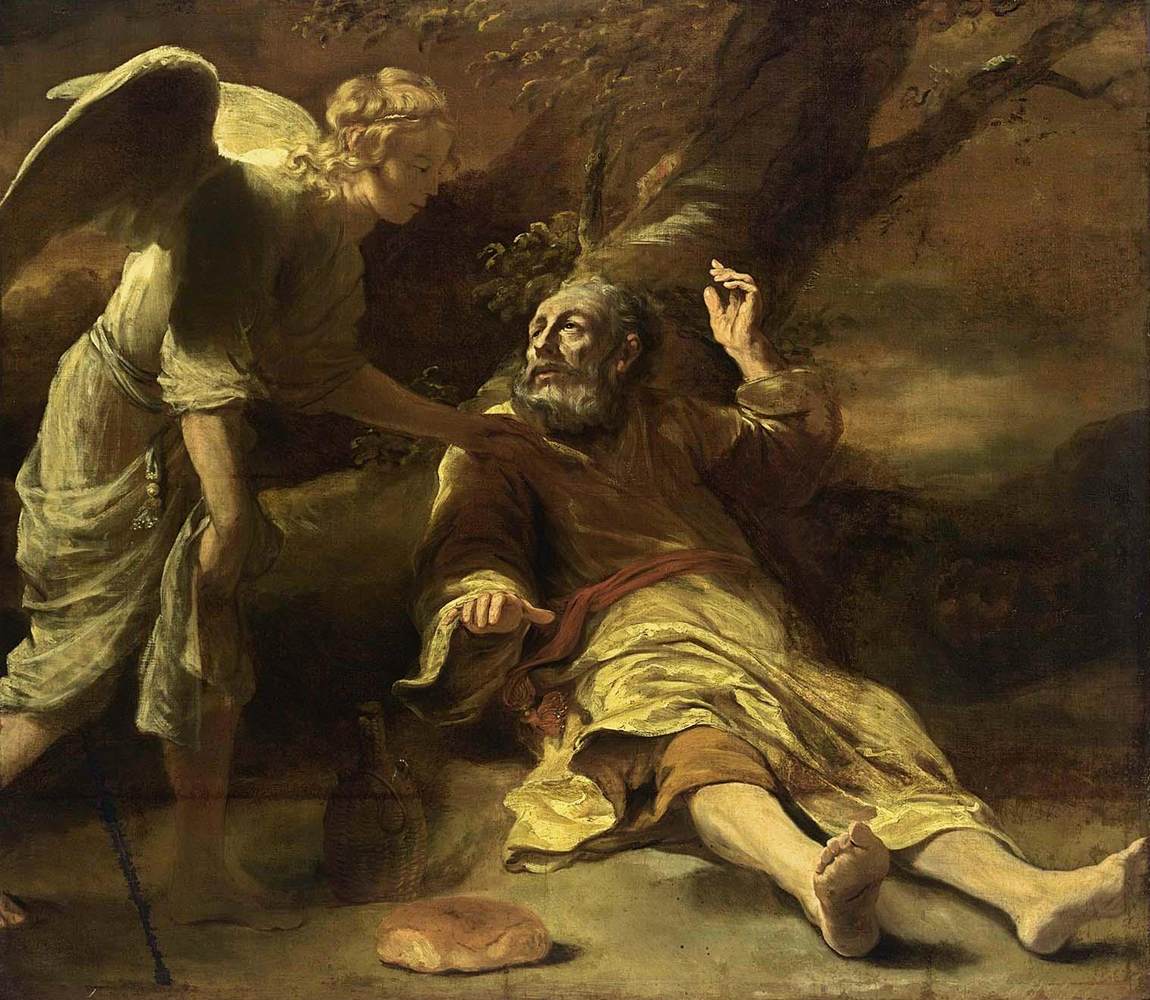
Then he lets him sleep more.
God cares for Elijah and can provide a model for how we can help each other.
One woman on YouTube (whose video I will link as soon as I find it again) who has experienced depression said the thing that she thinks helps the most is to look after small things: fix a sandwich, wash clothes, bring some tea...
When my aunt came in to see me in the hospital the next morning and found me in tears, she helped me wash my hair. Later, when I got out of the hospital, they took me to their house to look after me for 2 months. The people of St. Mark's, my home parish, brought me food and did all sorts of other simple, thoughtful things. One person brought sweet pea blooms from her garden. Someone else brought me a prayer shawl. My brother and sister-in-law drove to Beaumont to stay with me for a week; they talked to me and took me for walks. A friend offered me a temporary job and helped me find an apartment. And it went on and on.
I said we are going to make soup.

I've started it off, Madelyn and Nancy and Fr. Gotcher have contributed, along with some people from the internet. Now, I'd like you to add something.
Here's what I'm asking you to do: Remember a time you experienced God's care for you like Elijah experienced under the broom tree, and write about it. How were you ministered to? Don't try to tell then entire story - just focus on one instance of God caring for you, in whatever form that took.
Then, read over what you've written and consider whether it's something you'd be willing to share. Feel free to edit until you have what you are comfortable sharing. I recommend leaving out names, unless you specifically want yourself identified. Then, add it into the comments section below.
Something to keep in mind: Being ministered to doesn't mean that, afterwards, everything was solved; the angel woke Elijah up from his rest under the broom tree and gave him more food so he could walk an even longer distance - and then climb a mountain.
It can be a helpful thing to hear other people's experiences. It can also be a helpful exercise to look back on your own story and see God caring for you so that you can offer thanks if you didn't at the time (or again - no danger of offering God too much gratitude). Your stories may offer reassurance of God's presence and hope for someone else.
I also recommend reading how Elijah's story continues in the rest of 1 Kings 19 once he reaches Mt. Horeb.
